
Leaving the Canton Fair, you likely have a solid list of potential suppliers and preliminary quotes. But narrowing down that list to find a partner you can actually trust with your project is the real challenge.
The exhibition booths in Guangzhou are perfect for initial discovery, but they do not show you the full picture. Because the actual manufacturing hub for furniture and building materials sits just a short drive away in Foshan, experienced buyers make it their immediate next stop to verify capabilities and finalize orders.
This guide provides a straightforward 1-day verification route for international buyers. Instead of spending exhausting days navigating chaotic wholesale markets, we will show you how to streamline your sourcing trip. You will learn how to use a practical evaluation checklist, verify cross-category building materials in a single stop, and avoid the hidden costs of fragmented purchasing.
- Visit Foshan factories within one week after the fair to verify supplier quality.
- Ditch exhausting wholesale markets and verify cross-category alignment in a consolidated showroom.
- Use a practical checklist to evaluate pricing, quality, lead time, and true one-stop capabilities.
- Partner with a direct one-stop supplier to save the standard sourcing agent commission.
- Avoid skipping factory audits and misreading minimum order quantities and payment terms.
Why Foshan matters for building materials sourcing

Proximity and product specialization
Foshan sits roughly a 40-minute drive from the Pazhou Complex, where the Canton Fair takes place. This short travel time makes Foshan the natural next stop after the exhibition halls close. Buyers can leave Guangzhou in the morning, spend a full day visiting showrooms, and return to their hotel by evening. No other Chinese city offers this level of convenience for international sourcing teams.
The city’s manufacturing specialization runs deep across both construction materials and interior furnishings. While Foshan has accounted for more than half of China’s total ceramic tile production over the past decade, it is equally recognized as the largest furniture manufacturing hub in the region. The area houses thousands of specialized production lines dedicated to custom cabinetry, loose furniture, and structural woodwork.
Tip: Foshan’s concentration of manufacturing is well-documented. According to industry reports, Foshan has historically accounted for 54 percent of China’s total ceramic tile production, solidifying its position as a global leader in both building materials and furniture manufacturing.
This dual concentration means buyers find an unmatched density of tile manufacturers, sanitary ware producers, and furniture fabricators within a highly compact geographic area. You are not just sourcing raw construction materials; you can evaluate complete interior fit-outs in real time. The sheer variety of integrated building materials and furniture available here simplifies the entire procurement process for complex engineering and hospitality projects.
What the fair doesn’t show you
The Canton Fair 2026 gives you a first impression. You see samples, collect brochures, and hear sales pitches. But the fair cannot show you how a factory actually operates. You cannot inspect production lines, verify quality control procedures, or assess the working conditions of the workforce. Those details only emerge during a physical visit.
A factory tour reveals what a 3×3 meter booth cannot. But let’s be real: after walking miles of aisles at the Canton Fair, spending another three days navigating traffic to visit five different factories across Foshan sounds exhausting.
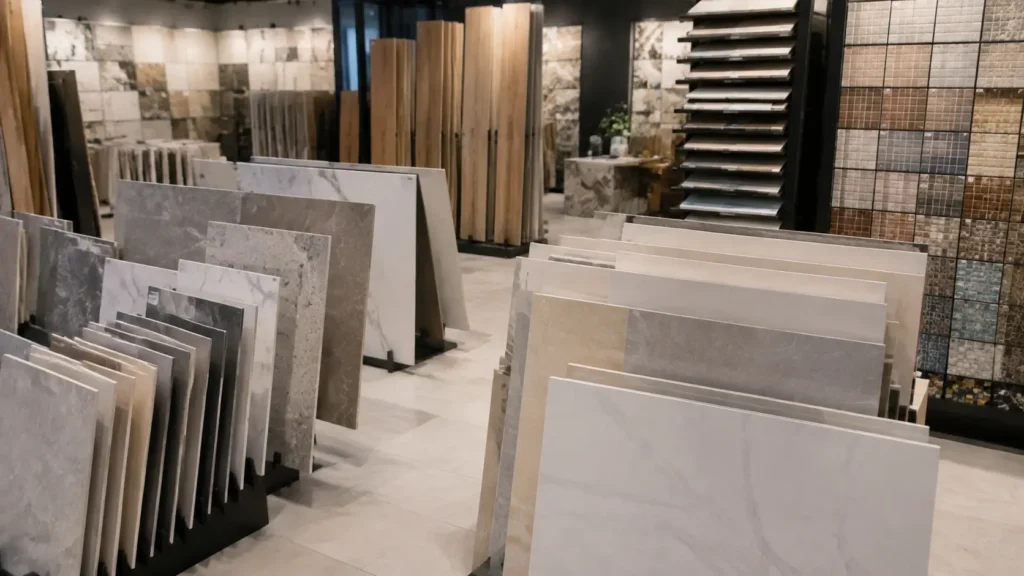
Your time is your most valuable asset. Instead of bouncing between scattered suppliers for tiles, cabinets, and hardware, smart buyers are shifting to comprehensive sourcing hubs. This is exactly where George Group provides a distinct engineering advantage. Rather than evaluating isolated samples, buyers can visit George Group‘s 30,000-square-meter integrated showroom in Foshan. A facility of this scale allows project managers to inspect full-size room mock-ups and verify that custom cabinetry, interior doors, and flooring align perfectly in a real-world environment. It is about replacing a chaotic three-day factory tour with one highly productive afternoon where you can finalize your entire project list under one roof. The Canton Fair 2026 introduces you to potential partners, but a physical verification of this scale confirms whether they deserve your trust.
Pre-fair: what to record before leaving Guangzhou
Key supplier data to capture
The Canton Fair 2026 moves fast. Conversations blur together. Booth numbers mix up. Prices get confused. You need a system before you leave the exhibition halls. Create a shortlist of 5-10 suppliers from the fair. Note their product lines, initial quotes, and contact persons. This shortlist becomes your roadmap for the days ahead.
Take notes immediately after meeting each supplier. Do not wait until evening. Memory fades quickly in a busy environment. Record booth numbers, product details, and pricing information on the spot. This practice simplifies follow-up communication after the exhibition. You will know exactly who offered what and at which price.
| Category | Specific Information to Record |
|---|---|
| Company Identification | Company name, booth number |
| Contact Details | Contact person’s name, WeChat ID |
| Product Information | Product details and specs |
| Commercial Terms | Pricing discussed, MOQ (minimum order quantity) |
| Logistics | Lead times mentioned, factory location |
| Qualitative Assessment | Impression of professionalism and capability, any red flags or concerns |
| Action Items | Follow-up actions needed |
Quick Tip: Bring a notebook or take photos of supplier booths during the fair. Record the booth number, company name, and key answers to your questions. This makes it much easier to follow up with suppliers after the exhibition.
Red flags in initial conversations
Not every supplier deserves a spot on your shortlist. Watch for warning signs during your first conversation. These red flags can save you from costly mistakes later in your sourcing journey.
Refusal to provide verifiable business registration information ranks as a high-severity flag. A registered manufacturer can produce their license on request. Demanding payment to personal accounts or via untraceable methods signals serious risk. These channels bypass dispute resolution and offer zero recourse. Company registration data that contradicts fundamental claims about the business should end the conversation immediately.
Watch for extreme evasion on factory audit requests. Reluctance or excessive delay in agreeing to a virtual audit suggests the reality does not match the online profile. A supplier who cannot clearly document a quality control process hides a non-existent system. Vague answers like “We inspect everything” mean nothing without defined standards. If they cannot explain their inspection procedures, quality failures become almost guaranteed.
Evasiveness about subcontracting deserves attention. A trustworthy supplier will openly disclose any subcontracting arrangements. Defensiveness on this question raises concerns, especially for products with complex compliance requirements. These red flags help you filter your canton fair 2026 contacts before you invest time in Foshan factory visits. Your supplier information from the fair becomes more valuable when you know which warning signs to spot.
Planning your Foshan visit: The 1-Day Efficiency Route
A structured plan turns a chaotic post-fair week into a productive sourcing trip. Instead of spending exhausting days bouncing between wholesale markets and scattered factories, smart buyers are condensing their verification process into one highly efficient visit at a comprehensive facility.
Cross-Category Verification in a Consolidated Showroom
Start by visiting a large-scale, integrated showroom—like the George Group headquarters in Foshan. Instead of looking at isolated tiles or single faucets in a crowded market, use this visit to verify how different materials actually work together.
Bring your project specifications and floor plans. A true one-stop partner will have an in-house engineering team ready to review your CAD drawings and confirm that your custom cabinetry, interior doors, and furniture will physically align perfectly in your specific layout. This cross-category verification is impossible to achieve if you are visiting different single-product factories for your furniture and building materials.
Finalizing QC Protocols and Consolidation Logistics
Beyond design alignment, this single visit should also secure your logistics and quality control. This is where you confirm the hard details. Review the supplier’s pre-inspection steps and physical testing protocols for items like ceramics or hardware, and check certifications for required standards on the spot.
More importantly, use this time to finalize your consolidation strategy. Determine how the supplier handles container loading (FCL) for mixed categories—like packing fragile sanitary ware alongside heavy tiles and bulky furniture. A capable integrated supplier will manage the pre-shipment inspection and supervise the entire loading process to prevent damaged goods.
By the end of this visit, you should have your floor plans reviewed, materials verified in a real-space setup, and a clear logistics plan in place—achieving in just a few hours what normally takes days of navigating Foshan traffic.
Building materials sourcing: a practical supplier checklist
The canton fair 2026 hands you a stack of business cards. The real challenge begins when you must decide which suppliers deserve your time and money. A structured evaluation checklist turns that decision into a repeatable process. It removes guesswork and emotion from the selection. You compare vendors against the same criteria every time. This approach improves sourcing efficiency and leads to better long-term partnerships.
Criteria for pricing, quality, and lead time
Start with the criteria that matter most for building materials. Product quality sits at the top of the list. You need defect rates, non-conformance reports, and corrective action history. Ask for certifications and audit findings. A supplier who cannot document quality control will not deliver consistent results. The quality of your final project depends on this single factor.
Price comes next, but not as a simple number. Look at purchase price variance and cost stability. A low quote that rises after you commit creates budget problems. Invoice accuracy also matters. Hidden fees and billing errors erode your margin. Compare total cost of ownership, not just the unit price.
Lead time determines whether your project stays on schedule. For custom building material packages ordered from Foshan factories, the realistic planning band is 30 to 60 days from confirmed specification to ex-factory, before ocean freight. This window includes production and quality control. Factor this timeline into your project plan before you commit.
MOQ flexibility rounds out the commercial criteria. Some suppliers demand large minimum orders. Others accommodate smaller trial batches. A flexible MOQ lets you test product quality before scaling up. Export experience also deserves attention. A supplier who ships internationally understands documentation, packaging standards, and customs requirements.
Evaluating communication and responsiveness
Communication quality separates good suppliers from frustrating ones. Response time to purchase order changes matters. Issue resolution speed matters. A supplier who answers within hours shows commitment. One who takes days creates risk. Communication reliability affects every stage of your project.
Forget complex math and weighted scores. When you’re standing in Foshan trying to make a decision, use this quick, practical checklist to see if a supplier is truly capable:
- The ‘One-Stop’ Test: Can they handle your tiles, cabinetry, and sanitary ware together, or will you have to manage five different vendors yourself?
- The Consolidation Test: Do they offer professional warehousing to mix your different materials into a single container (FCL), saving you massive shipping headaches?
- The Real-Space Test: Do their showrooms just display loose samples on a rack, or do they show how materials actually fit together in real room setups?
- The Direct Communication Test: Are you talking to someone who understands project floor plans, or just a middleman forwarding emails?
If you find a partner who checks all these boxes, you have found a reliable long-term supplier, not just a one-time seller. A disciplined approach to evaluation helps you identify suppliers who can genuinely support your engineering projects for years. Your supplier information from the Canton Fair 2026 becomes actionable data instead of scattered notes. Foshan offers an unmatched density of manufacturers, and this checklist helps you navigate that density with confidence.
Leveraging local sourcing services in Foshan
The Smarter Alternative to a Sourcing Agent
Many first-time buyers hire local sourcing agents to manage the chaos of Foshan, typically paying a 5% to 15% commission. While agents can handle logistics, they don’t control the manufacturing process.
A more efficient (and cost-effective) route after the Canton Fair is partnering directly with a comprehensive building materials supplier like George Group. You get the best of both worlds: factory-direct pricing without the middleman commission, plus the dedicated logistical support you’d expect from an agent—from strict quality control to loading all your different products into one consolidated container.
Common mistakes to avoid after the fair
Skipping factory audits and trusting samples
A polished sample can hide a chaotic production floor. Many buyers judge a supplier by the quality of a single tile or faucet. That sample may have been hand-selected, carefully packed, and shipped with extra attention. The bulk order will not receive the same treatment. Factory audits reveal what samples cannot: production capacity, documented quality management systems, and working conditions.
Skipping these audits creates serious risks:
- Financial risk: Loss of deposits paid to suppliers who cannot fulfill orders.
- Quality risk: Partnering with factories lacking documented quality management systems leads to inconsistent output.
- Reputational risk: Association with unethical practices causes brand damage.
- Operational risk: Production delays and communication breakdowns stem from poor management or insufficient capacity.
Defective building materials compromise structural safety. These defects impact revenue, customer satisfaction, and supply chain performance. They also risk non-compliance with industry regulations. A two-hour factory visit prevents months of problems. The foshan factories you shortlisted after the canton fair deserve this verification step.
Misreading MOQs and payment terms
Minimum order quantities confuse many buyers. MOQ is not a market standard. Each supplier sets its own minimums. One factory may require a full container. Another accepts LCL shipments. Sample MOQ and bulk MOQ differ significantly. Using sample pricing to estimate bulk costs leads to major errors. A 500 sqm villa project needs different sourcing than a 5000 sqm hotel. The right supplier for one may be wrong for the other. Ask about MOQ upfront. Discovering a supplier cannot meet your volume after the quote stage wastes weeks.
Payment terms create another common pitfall. A structure with a modest upfront amount, another portion after a vague milestone, and the rest upon completion invites disputes. Buyers must perform first and then collect from a company with no assets outside China. Paying the bulk before shipment removes leverage. Suppliers may delay or compromise quality without consequence. Always confirm negotiated terms in writing before paying any deposit. A written purchase order protects both parties. The canton fair 2026 introduced you to these suppliers. The canton fair 2026 contacts remain fresh for a short window. Use that time to verify factories, clarify terms, and secure reliable partnerships. Your foshan sourcing trip should include these checks. The energy of canton carries into your sourcing decisions.
The Canton Fair 2026 marks the starting line, not the finish line. A structured post-fair plan in Foshan separates successful buyers from those who face delays. This Foshan building materials guide provides the checklist and route you need. Use them to verify factory operations, compare quotes, and negotiate terms. The canton fair 2026 contacts remain fresh for only one week. Act quickly. Visit foshan factories while your notes stay clear. Apply the sourcing plan from this guide. Check factory quality, confirm MOQs, and clarify payment terms. These tips improve sourcing efficiency. Building materials decisions deserve careful attention. Reliable suppliers emerge from disciplined evaluation. The fair introduced you to possibilities. Foshan confirms which ones deserve your trust. Start planning your Foshan visit today, and turn fair leads into reliable partnerships.
FAQ
How soon after the Canton Fair should I visit Foshan?
Visit within one week. Your notes and contacts stay fresh. The canton fair shows you possibilities. Foshan factories confirm your choices. This foshan building materials guide recommends a quick transition. It improves your sourcing plan.
What is a typical minimum order quantity for ceramic tiles?
MOQs vary by supplier. Some require a full container. Others accept smaller orders. Always ask about minimum quantities before negotiating. The canton fair experience helps you ask better questions.
How can I verify a factory’s quality during a visit?
Inspect production lines directly. Check raw material storage. Ask about quality control procedures. Request documentation on the spot. A well-run factory welcomes these questions.
Should I use a sourcing agent for my first Foshan trip?
If you plan to buy from dozens of small, scattered wholesale shops, an agent is helpful to manage the chaos. However, if you partner directly with a comprehensive one-stop building materials supplier, you can eliminate the agent commission while receiving the exact same consolidation and quality control services directly from the source.