
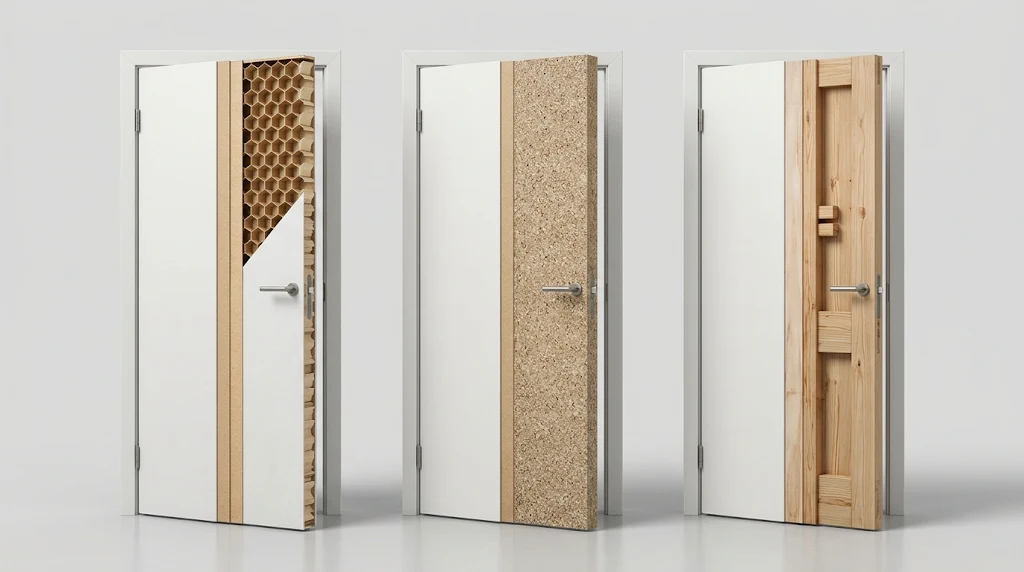
Here is a quick test. Walk to any interior door in your home and knock on it.
A hollow, echoing thud? You have a hollow core door. A flat, dead knock with almost no resonance? That is a solid core. If the door also swings with real weight behind it — closer to a bank vault than a closet panel — you are probably touching solid wood.
All three can look identical when closed. Same paint, same panel design, same hardware. But inside, they are completely different products, and the differences show up every day: in how much sound crosses the hallway, how the door survives a decade of use, and how the whole house feels when a door closes.
This guide opens all three up and tells you which one belongs in which room.
What’s actually inside each door
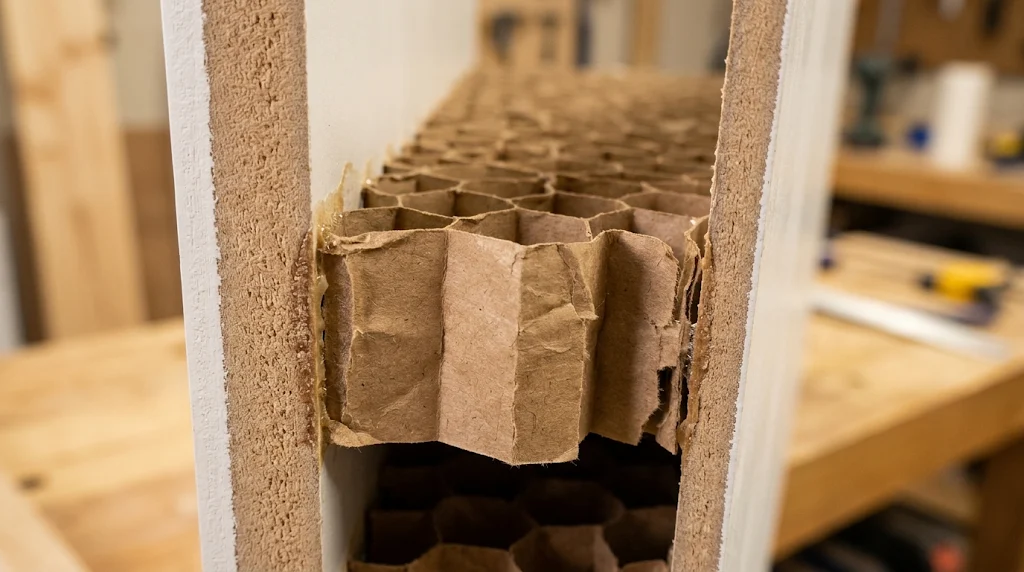
Hollow core is a sandwich of two thin skins — molded MDF or hardboard — over a wood frame, with a cardboard honeycomb filling the gap. That honeycomb is the whole trick: it holds the skins apart, weighs almost nothing, and costs almost nothing. Total weight: 20 to 35 pounds.
Solid core uses the same skins, but the middle is a dense slab of particleboard, MDF, or mineral composite. Despite the name, it is not solid wood — it is engineered fill, and that is not a bad thing. The dense, uniform core is exactly what makes it quiet and stable. Weight: 50 to 90 pounds.
Solid wood is lumber all the way through — typically stile-and-rail construction with real wood panels. It is the heaviest (90 to 130+ pounds), the most expensive, and the only one of the three that can be sanded and refinished for decades.
Style is skin. Core is the fill.
Here is the misunderstanding that trips up most buyers: the panel design you see and the core inside are two independent choices. A shaker door can be hollow core, solid core, or solid wood. So can a flat flush door, a 2-panel, or a 6-panel colonial. The molded skin is stamped in the same press regardless of what goes behind it.
This is good news. It means you never have to pick between the look you want and the performance you need. Choose the style for the room’s design, then choose the core for the room’s job — privacy, durability, or code compliance. Any quote that forces a trade-off between the two is a red flag about the supplier, not the door.
The three-way comparison
| Hollow Core | Solid Core | Solid Wood | |
| Core | Cardboard honeycomb | Particleboard / MDF / mineral | Natural lumber |
| Weight (32″×80″) | 20–35 lbs | 50–90 lbs | 90–130+ lbs |
| STC sound rating | 20–25 | 27–35 | 33–38+ |
| Speech through door | Clearly audible | Muffled, unintelligible | Reduced to a murmur |
| Fire rating | None | 20-minute versions available | Varies by construction |
| Dent / impact resistance | Low | High | High (and repairable) |
| Warp resistance | Low | High | Moderate (moves with humidity) |
| Typical lifespan | 20–30 years | 40+ years | 50+ years |
| Door-only price (2026) | 30–400 | 70–500 | 160–590 |
Price data: Angi’s 2026 cost data. STC and weight ranges: acoustic and millwork industry data.
The cost-per-year math most comparisons skip
Sticker price favors hollow core. Lifespan changes the arithmetic. Divide a mid-range door’s price by its service years:
| Typical Price | Typical Lifespan | Cost Per Year | |
| Hollow core | ~$100 | ~25 years | ~$4 / year |
| Solid core | ~$200 | ~40 years | ~$5 / year |
| Solid wood | ~$350 | ~50 years | ~$7 / year |
For one extra dollar per year, the solid core door buys you real sound privacy, better hardware holding, and a door you will not replace when the first one dents. Across a 12-door house, that is roughly $12 a year — less than one pizza — for a noticeably quieter home. This is also the math worth showing clients: on a per-year basis, upgrading the core is one of the cheapest performance decisions in the whole build.
Sound: the difference you notice first

Sound blocking is the number one reason people upgrade, and the physics here are simple: mass blocks sound. Acoustics engineers call it the Mass Law — every doubling of a barrier’s weight buys you roughly 5 to 6 decibels of extra sound reduction.
A solid core door is about three times heavier than a hollow core one. That translates directly into Sound Transmission Class (STC) rating:
- STC 20–25 (hollow core): normal conversation passes through the closed door almost word for word
- STC 30–33 (solid core): loud speech is faintly audible but the words are gone
- STC 35+ (solid wood): speech becomes a murmur — enough privacy for video calls
One honest caveat: the door is only part of the system. The half-inch gap at the bottom and the seams around the frame can leak a large share of the sound no matter what core you buy. A solid core door with a $15 door sweep beats a solid wood door with a drafty gap. (The same logic applies to windows, by the way — we covered it in our soundproof windows comparison.)
Durability and feel
Knock a knee into a hollow core door and you may go straight through the skin — repairs are difficult and usually mean replacing the slab. Solid core doors shrug off the same hit, hold screws and hardware far better, and resist warping because the engineered core doesn’t move the way lumber does.
Then there is the part nobody puts on a spec sheet: feel. A heavy door that closes with a quiet, dense thud reads as “quality” to anyone walking through the house. Builders and realtors know this — it is one of the cheapest perceived-value upgrades in a home, and buyers notice it in walkthroughs even if they can’t name why.
Solid wood adds one more dimension: it can be sanded, re-stained, and refinished. A good stile-and-rail wood door is genuinely a 50-year product. The trade-off is that natural wood moves with humidity, so it needs proper sealing — and in very humid or coastal climates, engineered cores often hold their shape better.
One compliance note for buyers sourcing internationally: composite cores are regulated products. Any particleboard or MDF core sold into the US must meet CARB Phase 2 / TSCA Title VI formaldehyde emission limits. Reputable factories certify as standard practice — but ask for the test report. A supplier who cannot produce one is telling you something.
Fire rating: the overlooked line item
Hollow core doors carry no fire rating. Solid core construction is where rated doors begin — 20-minute fire-rated versions are standard products, and mineral-core doors go higher. This matters more than most homeowners realize: building codes in many markets require a rated door between the garage and the house, and hotel or multifamily unit entries typically need 20- to 45-minute ratings. If a door in your project touches a code requirement, the decision is already made for you.
Which door goes where (room-by-room spec)
This is how professionals actually specify a house — spend where it matters, save where it doesn’t:
Solid core:
- Master bedroom and all bathrooms (privacy is the point)
- Home office (STC 30+ keeps calls private)
- Media room, laundry room (contains appliance noise)
- Door from garage to house (check your local fire-separation code)
- Kids’ rooms, if anyone sleeps while someone else is awake
Hollow core:
- Closets, pantries, linen and mechanical rooms
- Secondary bedrooms on a tight budget
- Louvered versions for AC closets and water heaters that need airflow
Solid wood:
- Feature openings where the door is part of the design — studies, libraries, primary suites
- Stain-grade work where the grain is the finish
- Projects where 50-year service life justifies the price
A typical home lands around 60–70% solid core and the rest hollow core. That mix gets you nearly all the performance at roughly two-thirds the all-solid-core budget.
One hardware note before you hang a heavy door
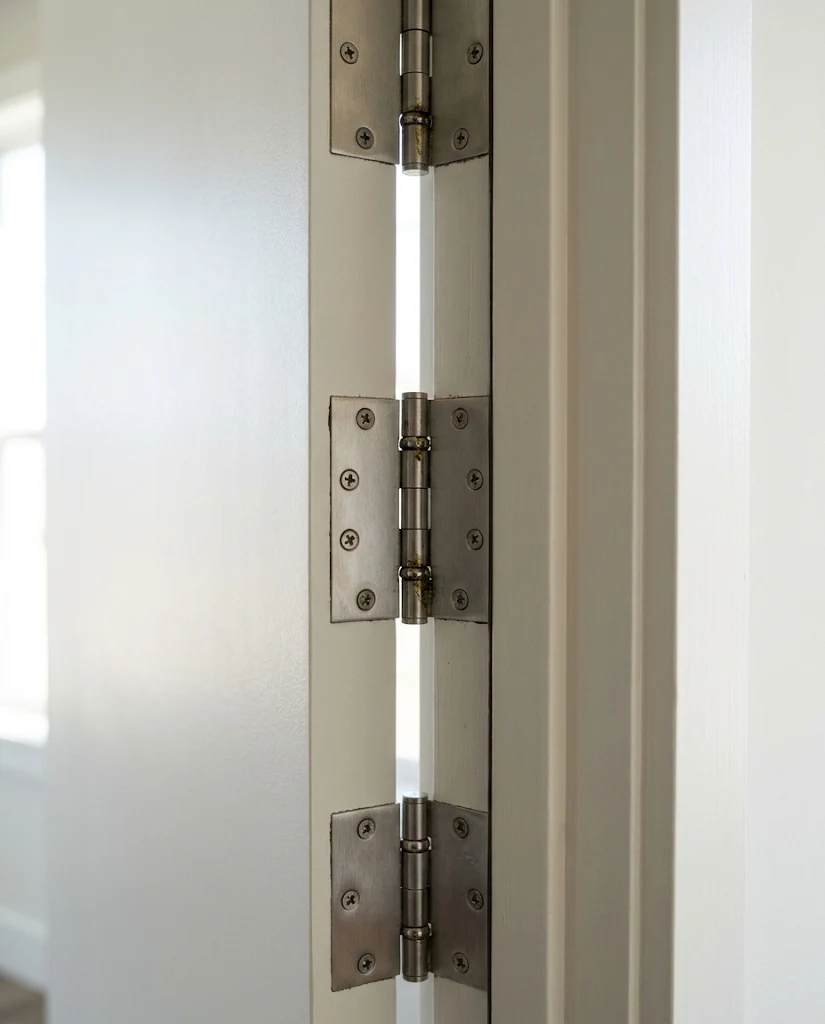
A solid core slab on two standard hinges will sag. It is not a question of if. Use three hinges on any solid core door, and step up to ball-bearing hinges on doors wider than 32 inches. The hinges cost a few dollars more; a sagging door costs a re-hang. (Need a refresher on hinges, jambs, and strike plates? Our parts of a door guide maps every component.)
Frequently asked questions
Can you trim a hollow core door to size?
Barely. The wood frame inside the edge is only about an inch thick — trim more than 5–10 mm off any side and you cut through the frame into the honeycomb, leaving nothing for the screws to hold. Solid core doors forgive a lot more here, which is one reason installers prefer them in older homes with out-of-square openings.
Can I replace a hollow core door with a solid core door on the same frame?
Yes, the frame usually stays. But plan on two upgrades: a third hinge (the extra 30–50 pounds will sag on two), and possibly new hinge mortises if the old hinges are not rated for the weight. Budget 30 extra minutes per door.
Is solid core worth it for a bedroom?
If anyone in the house sleeps while someone else is awake, yes. It is the single most noticed upgrade for the money — the difference between hearing every word of the TV and hearing nothing at all.
Do solid core doors add value to a home?
Not as a line item on an appraisal — but buyers feel them. The weight and quiet close of a solid door reads as overall build quality during walkthroughs, and perceived quality is what moves offers. For the price, few upgrades punch above their weight like this one.
Can you paint hollow core and solid core doors the same way?
Yes. Both use the same primer and paint, and from the hallway a painted hollow core and a painted solid core door are indistinguishable. The difference is everything you can’t see: weight, sound, and what happens when something hits the door.
Is “solid core” the same as “solid wood”?
No — and this is the industry’s most confusing naming. Solid core is engineered fill (particleboard, MDF, or mineral) under a wood or molded skin. Solid wood is natural lumber all the way through. Solid core costs roughly half as much and, for painted doors, delivers nearly the same feel and sound performance.
The bottom line
Hollow core is not a bad product — it is the right product for a closet. Solid core is the workhorse: triple the weight, real sound privacy, 40-plus-year durability, and fire-rated options, at roughly 2–3x the price. Solid wood is the heirloom choice for openings where the door itself is a design feature.
Buy for the room, not the showroom. Nobody ever regretted a quiet bedroom door.
Specifying doors for a home, hotel, or multifamily project? George One-Stop Furnish manufactures interior doors in hollow core, solid core, and fire-rated constructions — with matching frames, hardware, and one-stop consolidation alongside your cabinets, windows, and flooring. Send your door schedule for a quote within 48 hours.
Related reading:
- Interior Door Cost Guide 2026: What You’ll Actually Pay Per Door
- Parts of a Door: The Door Components Guide
- Soundproof Windows Compared: Which Solution Works Best
Sources:
- Angi, How Much Does Interior Door Installation Cost? [2026 Data] — material price ranges: hollow core
30–400, solid core70–500, solid wood160–590 - Double Door Knowledge Center — STC ratings by core type (20–25 / 30–35 / 33–38+), acoustic Mass Law (+5–6 dB per doubling of mass), door weight ranges
- GM Millwork, Solid Core vs. Hollow Core: Which Door Where? — room-by-room specification practice, three-hinge requirement, 20-minute fire-rated solid core doors
- Burton Acoustix, How To Soundproof A Door — STC 27–30 solid core vs 20–25 hollow core, gap leakage as limiting factor
- Lifetime Building Supply, Solid Core vs Hollow Core Interior Doors — lifespan data (20–30 yrs vs 40+ yrs), impact and warp resistance