
Last reviewed: October 2026
Two importers can ship the same 40HQ container of furniture from China, with the same FOB value on the commercial invoice, and receive landed-cost bills that differ by a factor of three. The difference is not negotiation skill, and it is not the freight rate. It is what is inside the container — because furniture is not one tariff. It is a tariff table. A wooden wardrobe, an upholstered sofa, and a mattress can sit on the same purchase order and face completely different duty stacks at the US border, and the single biggest variable in that stack is not the product price but the factory that made it.
This article lays out which furniture categories carry anti-dumping and countervailing duties, which ones do not, how the full duty stack builds from Column 1 upward, and how to plan a container when volume — not weight — is what runs out first.
Quick answer — what “the tariff on Chinese furniture” actually comes down to:
- There is no single rate. Wooden bedroom furniture carries a China-wide anti-dumping rate of 216.01%; upholstered seating, dining furniture, and office furniture are not covered by any AD/CVD order at all. Mattresses are a separate, extreme case.
- The factory matters as much as the product. Factories with their own separate rates under the wooden bedroom furniture order can clear at rates close to zero, while the China-wide rate for everyone else is 216.01%.
- The question to ask is not “what is the duty on furniture” — it is “what is the duty on this product, from this factory” — and any supplier who cannot answer the second half of that question in writing is telling you something.
All rates cited here reflect the October 2026 duty position, based on public Federal Register notices and Commerce Department orders. Rates change through administrative reviews and new measures — confirm the current figures with your customs broker before pricing an order. Nothing here substitutes for a broker’s classification ruling.
What Furniture Actually Costs: Two Identical Containers, Two Very Different Bills
Picture two 40HQ containers leaving Foshan in the same week, each declared at $40,000 FOB.
Container A holds a hotel project: upholstered sofas, dining chairs and tables, casegoods in rattan, office desks for the back-of-house. At the border it pays Column 1 duty (typically 0–5.3% depending on the HTS line), the Section 301 tariff of 25%, and MPF/HMF of roughly 0.47% combined. The duty stack lands somewhere around 30% of entered value.
Container B holds the same dollar value in wooden bedroom furniture — beds, nightstands, dressers, wardrobes — bought from a factory that ships under the China-wide rate. On top of the same 25% Section 301 and fees, it absorbs an anti-dumping deposit of 216.01%. The duty stack lands near 245% of entered value. Same container, same invoice total, roughly eight times the duty bill.
That is not a hypothetical spread engineered for effect. It is the mechanical result of how US trade remedy law is written: by product scope, and by producer. Understanding those two dimensions is the entire game in furniture importing — and it is what the rest of this article is about.
The Three Product Groups That Sit Inside an AD/CVD Order
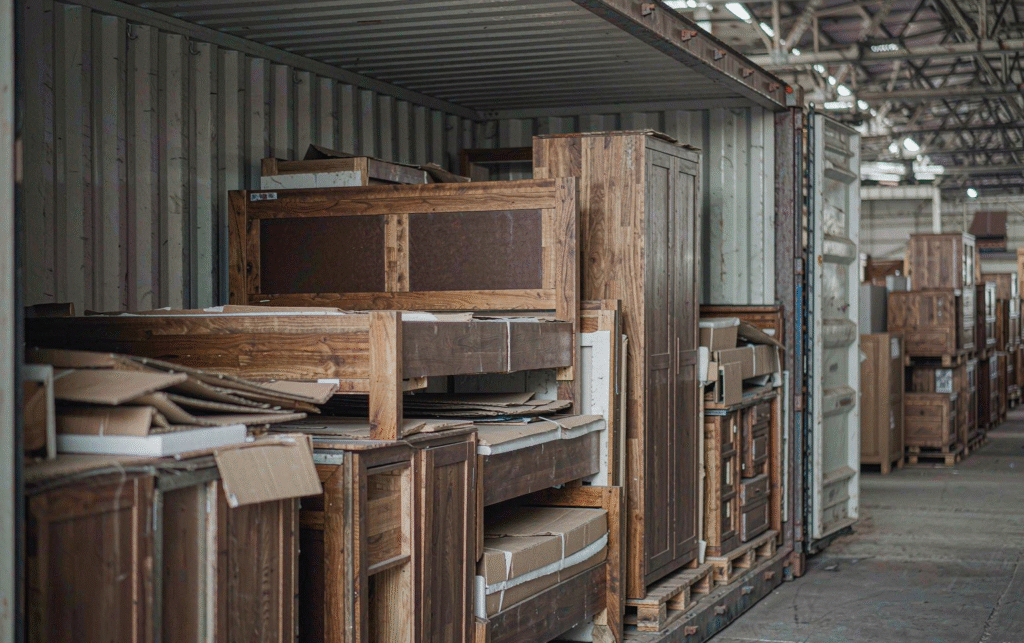
Anti-dumping and countervailing duty orders do not cover “furniture.” They cover specifically defined products, each with its own case number, scope language, and rate structure. Three orders matter most for furniture buyers.
| Product group | Case | China-wide rate | Notes |
| Wooden bedroom furniture | A-570-890 (AD) | 216.01% | In force since Jan 4, 2005; continued after the 2022 sunset review (87 FR 56397); next sunset review August 2027. Separate-rate factories can clear far lower — some near 0%. |
| Wooden cabinets and vanities | A-570-106 (AD) / C-570-107 (CVD) | AD up to ~262.18%, CVD ~293.45% | Also pulls in Section 232 timber measures (25% — verify with your broker, as guidance on this layer has been less consistent). |
| Mattresses | A-570-092 (AD) | China-wide rate extreme — one published figure is 1,731.75% | Treat any mattress quote from China as a compliance project, not a sourcing project, unless the factory holds its own rate. |
Two discipline points before you use this table.
First, scope controls, not the HTS code. The wooden bedroom furniture order lists HTS lines such as 9403.50.9040 and 9403.50.9080, but the legal test is Commerce’s written scope description. A product can sit inside the HTS line and outside the scope, or the reverse. Classification questions go to your broker or to a scope ruling — not to a blog post, including this one.
Second, the order names its exclusions explicitly. Seating, dining room furniture, office furniture, cribs and toddler beds, and bedroom furniture made of rattan, bamboo, or wicker are all carved out of A-570-890. Read that list again — it is essentially a map of where the margin is.
The Products That Don’t — and Why That Matters More
The categories with no AD/CVD order against China read like a whole-home furnishing list:
- Upholstered seating — sofas, sectionals, armchairs (HTS 9401 lines)
- Dining furniture — tables, chairs, sideboards
- Office furniture — desks, task seating, storage
- Rattan, bamboo, and wicker furniture — explicitly excluded from the bedroom order
- Cribs and children’s furniture — also excluded from A-570-890 (though CPSC safety rules apply with full force)
For these categories, the duty stack is Column 1 + Section 301 + fees — the ~30% neighborhood from Container A. That is a cost you can model, quote around, and compete with. The 216% stack is not.
This shapes rational buying behavior in a way few suppliers say out loud: the strongest furniture categories to source from China are precisely the ones nobody writes tariff headlines about. Sofas do not make the trade press. They also do not triple your duty bill. A buyer furnishing a hotel, a rental development, or a retail container program can build an entire product mix from unencumbered categories — and when wooden bedroom pieces are genuinely needed, source them only from a factory that holds its own separate rate. Which brings us to the most valuable question in this article.
The Factory Question Worth 216 Points
Under US anti-dumping law, the China-wide rate is the default. It applies to every exporter that has not demonstrated independence from government control and received its own rate through an investigation or administrative review. Factories that have done so ship under their own separate rates — and under A-570-890, some of those rates are close to zero.
The spread between “close to zero” and 216.01% is decided entirely by which factory you buy from. Not by the product, not by the price, not by the port.
So before you place an order that includes wooden bedroom furniture, ask the supplier three questions, in writing:
- Does your factory hold its own separate AD rate under A-570-890? Not “can you handle the customs paperwork” — a specific yes or no about a specific rate.
- What is the rate, and under which review was it established? A real answer names a number and a proceeding. A vague answer is a no.
- Whose name appears as the exporter/manufacturer on the entry documents? The separate rate follows the producer-exporter combination. If the name on the paperwork is not the entity that earned the rate, the China-wide rate applies — and CBP collects retroactively, with interest, from the importer of record. That importer is you.
Most factories cannot answer the first question — and most buyers never ask it. That asymmetry is where the margin hides. A supplier who answers all three questions in writing, with the rate and the proceeding named, has just saved you more than any discount on the FOB price ever will.
Building the Duty Stack
Duty on furniture from China is not one number but a stack of independent measures, each with its own legal basis. From the bottom up:
| Layer | Typical rate | Basis |
| Column 1 (MFN) duty | 0–5.3% depending on HTS line | HTSUS general rates |
| Section 301 (List 3) | 25% | USTR China measures — applies to most furniture HTS lines |
| Section 232 timber | 25% on covered wood products (cabinets, vanities) | Verify scope with your broker — guidance here is less settled than the AD/CVD layers |
| AD/CVD, if in scope | 0% (separate rate) to 216.01%+ (China-wide) | Commerce orders A-570-890, A-570-106/C-570-107, A-570-092 |
| MPF + HMF | 0.3464% + 0.125% | Standard merchandise processing and harbor maintenance fees |
Worked example — a $10,000 shipment of upholstered dining chairs (no AD/CVD): Column 1 at, say, 0%, plus 25% Section 301, plus ~0.47% in fees. Duty stack ≈ **25.5%**, or roughly $2,550.
The same $10,000 in wooden nightstands from a China-wide-rate factory: 5.3% Column 1 + 25% Section 301 + 216.01% AD + fees. Duty stack ≈ **246.7%**, or roughly $24,670 — nearly two and a half times the value of the goods, before freight.
One more rule buyers learn late: AD/CVD deposits are not eligible for duty drawback. Section 301 duties and fees generally are recoverable through drawback programs if you re-export or qualify under substitution rules — anti-dumping duties never are. Money paid into the AD line is gone permanently.
What Actually Fits in a 40HQ
Furniture economics invert the usual container math. With stone or tile, you hit the weight limit with space to spare. With furniture, you run out of cubic meters while the container is still light — a 40HQ gives you roughly 76 CBM of usable volume, and most furniture loads close out well under the weight ceiling.
That makes volume planning the real discipline. Two reference loads:
| Load profile | What fits | Approx. volume |
| Three-bedroom home, whole-house | 3 beds + nightstands, wardrobes, sofa set, dining table + 6 chairs, desks, TV unit, side tables — flat-packed where possible | ~55–68 CBM — one 40HQ with careful loading |
| Hotel standard room furniture, per room | Bed base + headboard, nightstands ×2, desk + chair, wardrobe, lounge chair, luggage bench | ~4–6 CBM per room — roughly 12–16 rooms per 40HQ |
Three practical consequences:
- Mixed containers are the norm, not the exception. A project order bundles sofas, casegoods, lighting, and hardware into one load plan. The buyer who plans the cube line-by-line ships fewer containers per project than the buyer who plans by product.
- Foam, fabric, and air are what you are actually paying to move. Upholstered pieces cannot compress; flat-packed casegoods can. The ratio between the two in your load plan decides your freight cost per sellable unit.
- Packing quality is freight economics. Corner protection, carton spec, and loading pattern determine how much of your 76 CBM arrives sellable. Documented, row-by-row loading photos are not a courtesy — they are how you verify the cube you paid for.
Knocked-Down vs Assembled, and How the Entry Gets Filed
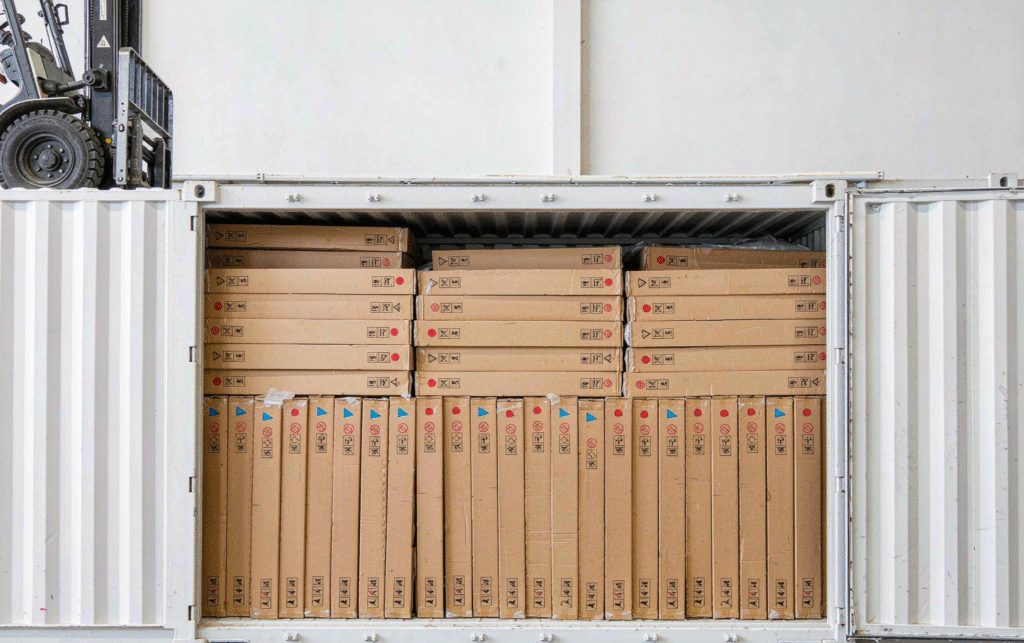
A recurring buyer idea: ship the wardrobe as flat-packed panels and hardware, declare it as parts, and sidestep the duty that applies to finished furniture. It does not work, and the reason has a name — General Rule of Interpretation 2(a).
GRI 2(a) states that an incomplete or unassembled article is classified as the finished article if it has the essential character of the finished article. A flat-packed wardrobe with all its panels, fittings, and instructions in one carton is, in customs law, a wardrobe. It enters under the finished-furniture HTS line, and — if it falls within an AD/CVD scope — it pays the full finished-goods rate. Disassembly is a packing method, not a classification strategy.
Buyers have built landed-cost models on the parts theory and received the correction as a CBP bill, sometimes years later with interest. File the entry for what the goods are. If a classification question is genuinely close, the legitimate route is a binding ruling request to CBP — decided before the purchase order, not after the arrival notice.
Furniture Sourcing at OneStopFurnish
Everything above is how the duty and loading math works when it works properly. Here is how it comes together with us:
One container, one quote, no middlemen. Sofas, bedroom sets, dining furniture, office lines, and hotel casegoods consolidate into a single order file and a single container plan — alongside cabinetry, windows, and doors if your project needs them. One accountable team from quotation to the loading photos.
Category-first duty planning. We quote by product line, and we tell you plainly which categories carry AD/CVD exposure and which do not — before you commit to a product mix, not after the deposit. The duty position of every line in your order is stated in the quotation, in writing.
Specification locked before production. Dimensions, materials, finishes, and hardware confirmed in writing — the hundredth unit built against the same signed document as the first.
Evidence at every stage. Pre-shipment inspection with photo and video; container loading documented row by row, so the cube you paid for is the cube that ships.
Terms that fit your operation. FOB if you run your own freight, CIF for the standard route, DDP if you want delivery with clearance handled.
Get a Furniture Quote for Your Project
Frequently Asked Questions
What is the import duty on furniture from China?
There is no single rate — it depends on the category and the factory. Most upholstered, dining, and office furniture pays roughly 25–31% in combined duties and fees (Column 1 + Section 301 + MPF/HMF). Wooden bedroom furniture carries an additional anti-dumping duty of 216.01% at the China-wide rate, though factories with separate rates can clear far lower. Mattresses and wooden cabinets face their own separate orders. All figures above reflect the October 2026 position — confirm current rates with your customs broker.
Is wooden bedroom furniture from China still subject to anti-dumping duties?
Yes. Order A-570-890 has been in force since January 2005 and was continued after the 2022 sunset review; the next sunset review is due in August 2027. The China-wide rate is 216.01%. The key variable is the factory: producers holding their own separate rates can ship at rates close to zero. Ask for the rate in writing before you order.
Can I avoid the anti-dumping duty by shipping furniture flat-packed as parts?
No. Under GRI 2(a), an unassembled article that has the essential character of the finished product is classified as the finished product. Flat-packed furniture enters as furniture and pays the full applicable rate. If a classification question is genuinely uncertain, the correct route is a binding ruling from CBP obtained before shipment.
Which furniture categories have no AD/CVD from China?
Upholstered seating, dining furniture, office furniture, rattan/bamboo/wicker furniture, and cribs are outside the existing furniture orders. They still pay Column 1 duty, Section 301 (25%), and fees — a manageable, modelable stack. Safety regulations (CPSC, flammability, CARB/formaldehyde for composite wood) apply regardless of duty status.
How much furniture fits in a 40HQ container?
A 40HQ offers roughly 76 CBM of usable volume, and furniture loads are limited by space, not weight. As a reference: a complete three-bedroom home’s furniture typically fills most of one 40HQ, and hotel standard-room furniture runs about 4–6 CBM per room — roughly 12–16 rooms per container, depending on the mix of upholstered versus flat-packed pieces.
Can furniture be shipped together with cabinets, windows, or doors in one container?
Yes — and for project buyers this is standard practice. A mixed building-materials and furniture load shares one order file, one container plan, and one set of documents, which reduces both freight cost per unit and the number of shipments to track. The duty math still applies per product line inside the container.
Sources and editorial notes: duty rates and case data are drawn from public Commerce Department orders and Federal Register notices, including the continuation of A-570-890 (87 FR 56397), and reflect the October 2026 duty position. The mattress China-wide figure of 1,731.75% is an extreme published value and should be verified before reliance. Section 232 timber measures cited here are based on available guidance that is less settled than the AD/CVD layers. All classifications, scopes, and rates must be confirmed with your customs broker before pricing or filing. Nothing in this article constitutes legal or customs advice.