

Sourcing stone from China is not simply a matter of comparing FOB prices. Buyers need to verify the stone itself, fabrication tolerances, supplier capability, packaging method, and destination import requirements before placing a large order.
For projects involving marble slabs, granite, quartzite, or cut-to-size stone, the most important controls are the approved sample, written technical specifications, factory inspection, production inspection, and shipment documentation. This guide explains what to verify at each stage.
Key Takeaways
- Verify technical specifications like thickness tolerance and surface finish to avoid costly rework.
- Audit suppliers to verify manufacturing capability, quality control, and responsibility for the products being ordered.
- Leverage China’s industrial clusters for specialized stone processing and competitive pricing.
- Understand import logistics and ISPM-15 packaging compliance to prevent customs delays.
- Build long-term supplier relationships for consistent quality and priority during high demand.
Technical Specifications for Sourcing Stone from China
Technical specifications form the foundation of any successful stone procurement strategy. Buyers who master these parameters avoid costly rework and protect their project timelines.
Stone Quality Specifications and Inspection Standards
Thickness should be specified against the product type, intended application, and applicable project standard rather than using a single universal tolerance. For example, ASTM C503/C503M covers marble dimension stone, while EN standards provide separate dimensional requirements for natural stone products. Buyers should state the nominal thickness, dimensional tolerance, flatness, squareness, and measurement method in the purchase specification and have the supplier confirm the agreed limits before production.
Surface finish standards demand equal attention. High-end export-grade finishes require consistent polish without dull spots. Buyers should verify finish consistency through standardized polishing steps and gloss measurement. Color and veining control also determines project success. Background color range must be defined and controlled before cutting. Vein direction requires mapping before nesting pieces. Bundle consistency matters most for large floor areas. Reserve compatible lots together to prevent abrupt background changes between rooms.
Certifications and Defect Prevention Checklist
Compliance requirements for Chinese stone exports involve multiple documentation layers. Quarry ownership validation includes business licenses showing mining rights, quarry lease deeds, and GPS coordinates. Depending on the stone and project requirements, buyers may request petrographic examination and physical-performance testing such as water absorption, density, compressive strength, or flexural strength. Export documentation includes customs registration, past Bill of Lading samples, and VAT invoices showing manufacturing status. Contractual safeguards should embed slab batch traceability clauses and penalties for origin misrepresentation. For EU-bound projects, buyers should verify the applicable customs classification, product requirements, and destination-specific environmental or construction regulations before shipment. CBAM should only be considered when the imported product falls within the EU’s covered CBAM goods.
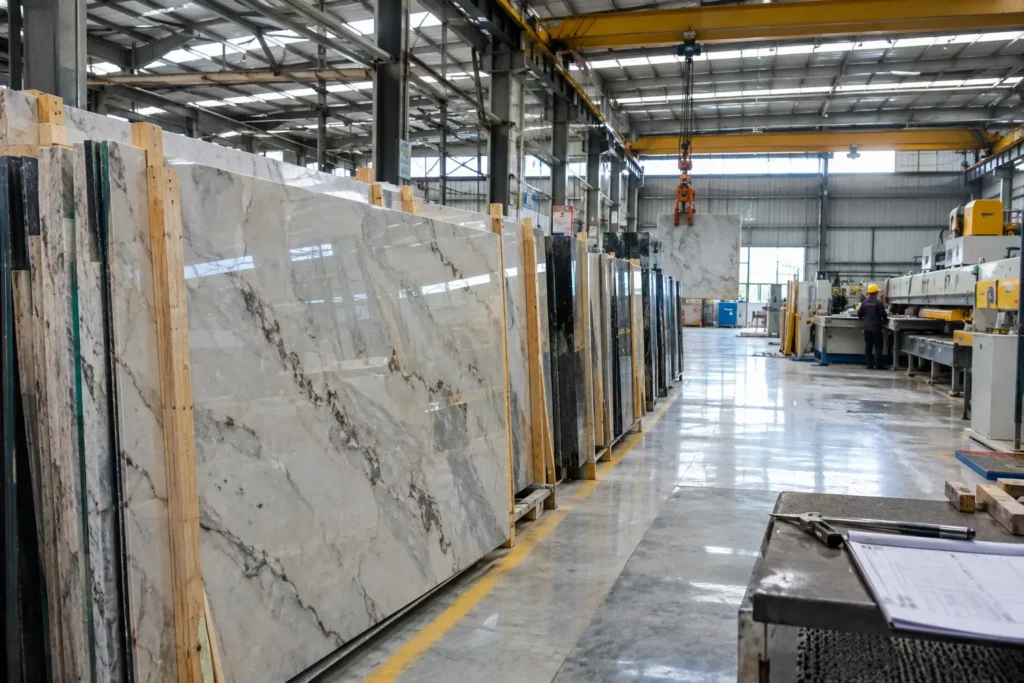
A practical defect prevention checklist helps buyers inspect bulk marble slabs and cut-to-size marble orders systematically. Inspect every slab within 24 to 48 hours of delivery. Photograph both faces and all four edges for damage records. Measure actual dimensions because nominal sizes may differ. Check the front face for chips, cracks, and scratches. Examine the back face for structural cracks. Inspect all edges and corners carefully, paying particular attention to slab corners, which are especially vulnerable to impact during handling and transport. Verify surface finish consistency and compare color and pattern to the approved sample. Measure thickness at multiple points specified in the project inspection plan and compare the results with the agreed purchase specification. Document any damage with photos and notify the supplier within the claim window.
Common defects include cracking, lippage, inconsistent thickness, color variation, and chipping. Cracks appear as thin elongated lines, and small cracks may follow veins. Wide cracks indicate poor quality. Inconsistent thickness means tiles are not uniform in size. Color variation is inherent in natural and engineered stone. Variation outside the approved sample or agreed acceptance range may be treated as a quality issue. Chipping or breaking may indicate material softness. Acceptance criteria should be defined in the purchase specification, including allowable edge damage, cracks, surface defects, and replacement procedures.
These quality control standards protect buyers from expensive surprises. Sourcing marble from China rewards those who verify every detail before shipment.
China’s Stone Processing Capabilities
China’s stone processing industry operates through established industrial clusters with distinct material specialties. Understanding these hubs helps buyers match project requirements with the right suppliers.
Major Industrial Clusters and Specialties
Several important stone-processing and trading clusters are located across China, each with different areas of specialization. Shuitou in Fujian acts as the global hub for marble, granite, and engineered stone. Guangdong’s Yunfu focuses on engineered and natural stone manufacturing. Shandong’s Laizhou provides granite raw blocks for large-format engineering projects. Hebei’s Quyang preserves hand carving traditions dating to the Han Dynasty.
Shuitou Town processes approximately 70% of all imported stone entering China. The cluster includes over 3,000 stone processing and trading enterprises with annual revenues exceeding USD 15 billion.
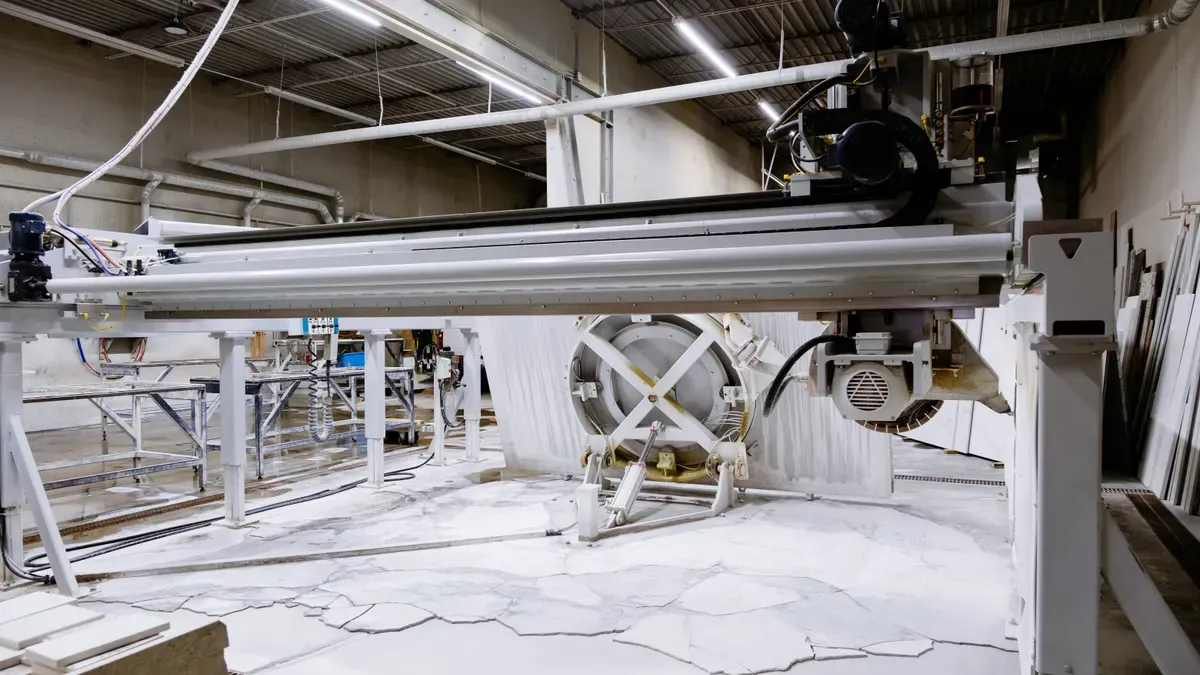
The integrated ecosystem combines advanced calibration technology with comprehensive logistics. Laser-aided positioning systems achieve cutting tolerances within ±0.5mm. Multi-axis CNC machines handle cutting, drilling, and shaping in single workflows. Tooling technology optimizes diamond segments for specific machine torque, enabling continuous feed rates of 7–9 m/min during granite processing. Water recycling and dust suppression systems address environmental compliance.
Verifying Real Manufacturers vs. Trading Companies
Distinguishing genuine manufacturers from intermediaries protects quality and pricing.
| Attribute | Manufacturer | Trading Company |
|---|---|---|
| Production | Own factory / production line | Outsourced or mixed |
| Technical staff | Engineers / QC team | Usually sales-led |
| Custom fabrication | Can support project-specific requirements | Depends on subcontractor |
| Factory audit | Directly verifiable | May require additional verification |
| Pricing | Factory-level quotation | May include intermediary margin |
Red flag: Unwillingness to conduct a video audit indicates high risk of misrepresentation.
Effective verification follows five steps. First, confirm physical existence at the stated address. Second, verify production capacity matches claimed output. Third, check quality control systems and ISO certifications. Fourth, assess working conditions. Fifth, ensure the factory manufactures the specific product ordered. Third-party factory audits are available from providers such as SGS and Bureau Veritas, but pricing varies by location, scope, and audit duration. Buyers should request a quotation based on the actual inspection requirements. Ask suppliers to show live footage of CNC machines processing your sample. Ask the supplier to provide documented monthly capacity and recent production lead times for comparable orders rather than relying on a generic capacity benchmark.
Working directly with a manufacturer can simplify technical communication and give buyers greater visibility into production and quality control. Factory direct sourcing also provides transparent communication with technical staff during production. Quality control standards improve when buyers supervise processing directly. For cut-to-size marble orders, direct factory relationships ensure consistent thickness verification throughout fabrication. Procurement teams that invest in supplier audits reduce risk substantially. Export documentation verification remains essential for customs clearance. Confident sourcing stone from China requires thorough validation through these verification methods.
Managing the Global Stone Supply Chain
Cost control and risk management separate profitable stone procurement from expensive lessons. The global stone supply chain rewards buyers who understand pricing structures, evaluate processing capabilities, and build supplier relationships that compound value over time.
Stone Pricing and Custom Processing
Stone pricing reflects more than material cost. Buyers must account for quarry extraction, block processing, calibration, surface finishing, packaging, and freight. Factory-direct purchasing can reduce intermediary costs, but buyers should compare the supplier’s total value, including quality control, fabrication capability, documentation, and logistics support. Negotiation benchmarks vary by order volume, material rarity, and finish complexity. Volume commitments and long-term agreements typically secure better terms than one-time purchases.
Regional specialization matters when selecting a Chinese stone supplier. Shuitou and Yunfu are important stone-processing centers, while Foshan provides a broader building-materials manufacturing ecosystem. Buyers should prioritize the supplier’s actual stone-processing capability and project experience rather than choosing a supplier solely by location.
Import Process, Logistics, and Supplier Relationships
The import process for stone products requires careful coordination across multiple stages. Buyers should engage a licensed customs broker early in the procurement cycle. The broker handles customs declaration submission with required documents including the commercial invoice, packing list, and bills of lading. Customs brokers file paperwork, calculate duties, and ensure regulatory compliance. Buyers must pay applicable customs duties and prepare for random or targeted customs inspections. Documentation requirements include commercial invoice, packing list, bill of lading, and certificates of origin. Import permits may be required for natural stone products depending on destination regulations.
Container logistics involve several sequential steps. Drayage arranges container transport from port to warehouse. The empty container returns to the shipping line after unloading. Final delivery completes the journey to the project site or warehouse. Customs factors include HTS code classification and country-of-origin marking. Buyers should also check the destination market for product-specific marking, documentation, and construction-product requirements where applicable.
ISPM-15 compliant packaging protects shipments and ensures regulatory acceptance. Solid-wood pallets, skids, crates, boxes, blocks, braces, and dunnage are regulated and must be treated and marked. Plywood, OSB, particleboard, and fibreboard are generally exempt from treatment scope. Thin wood measuring 6 mm or less is excluded. Solid timber skids or cleats under plywood-sided crates remain regulated and keep the whole package in scope. Loose wood added after assembly, such as wedges, is regulated and not covered by existing crate marks.
The ISPM-15 mark must include several elements. The IPPC symbol serves as the certification graphic. A two-letter country code identifies the origin. An assigned producer or treatment-provider code provides traceability. A treatment code such as HT for heat treatment confirms compliance. A hyphen between country code and producer code is required for US-bound shipments as of 2026. The mark must be legible, durable, non-transferable, and visible during use. Application to at least two opposite sides is preferred. Hand-drawn marks are prohibited.
US enforcement of ISPM-15 requirements tightened significantly. The US temporarily suspended hyphen enforcement between country code and producer code. That suspension ended December 31, 2025. APHIS and CBP resumed enforcement January 1, 2026, meaning previously tolerated marks now create compliance problems. APHIS updated importer guidance June 3, 2026. APHIS announced a wood-packaging compliance webinar with CBP for August 25, 2026. Regulators now focus on treatment, accredited packaging sources, noncompliant marks, pest evidence, and Emergency Action Notification responses.
Buyers should follow a structured approach to packaging compliance. Specify ISPM-15 requirements in the crate order before construction, naming the destination and requiring authorized-source packaging with defined evidence. Match crate design to stone characteristics including weight, orientation, center of gravity, lifting access, edge protection, and restraint while keeping regulated timber traceable. Inspect timber before cladding, foam, or stone hides the frame, checking for bark, exit holes, frass, pest activity, illegible codes, unmarked blocks, and mixed old or new wood. Recheck after repair and strapping because replaced runners or added forklift blocks invalidate earlier photos. Close the loading record by reconciling crate number, visible marks, container position, and final manifest.
A verification checklist helps buyers confirm packaging compliance. Identify every solid-wood skid, brace, block, wedge, and dunnage piece in the finished package. Verify IPPC symbol, country code, producer code, treatment code, and destination-specific mark format. Photograph the complete mark straight on and link it to the visible crate number. Check both sides after bands, wrapping, document pouches, and protective panels are installed. Hold any crate with pest signs, doubtful timber, hidden codes, unauthorized repairs, or added unverified wood. Reconcile released crate numbers with the manifest and loading-photo index before closing the container.
Common questions about ISPM-15 compliance have clear answers. Fully processed plywood is generally exempt, but the complete package may still contain regulated solid-wood skids, braces, blocks, or dunnage, so each component requires checking. A heat-treatment certificate alone is not enough if the crate mark is missing because import inspection relies on the official mark applied under the authorized system. Repair and remanufacture have specific controls, and replacement wood cannot be added under an old mark. If inspectors report noncompliant wood packaging, photograph the notice, mark, crate, container, and condition, and do not continue unpacking until reviewed.
Building long-term supplier relationships delivers measurable benefits. Select a supplier with proven expertise by evaluating years of quarrying and finishing experience, international certifications such as ISO and SGS, quality-control processes, and references from comparable projects. Establish clear communication channels by assigning dedicated account managers, providing regular production and shipping updates, and using digital tools for real-time order monitoring.
Transparent terms and agreements formalize expectations. Contracts should cover pricing with volume discounts and long-term price stability, quality standards including grading, finish, and defect thresholds, delivery schedules with realistic lead times and contingency plans, and claims and warranties. Regular on-site visits and audits allow buyers to inspect quarries and factories for production capability, environmental and labor compliance, and consistency of color, veining, and finish.
Long-term supplier relationships can improve consistency across repeat orders, simplify production coordination, and provide more predictable pricing and lead times. To make this work, buyers should keep approved samples, specifications, inspection records, and agreed claims procedures for future orders.
Accessing an extensive supplier network enables material comparison across multiple sources. Buyers who maintain relationships with several vetted suppliers can compare bulk marble slabs and cut-to-size marble options before committing to large orders. This competitive dynamic supports better pricing and quality outcomes. Sourcing stone from China through verified factory direct channels, clear specifications, and documented compliance protects both construction timelines and profit margins.
FAQ
What technical specifications should buyers provide when sourcing stone from China?
Buyers should specify the stone type, material name, slab or tile dimensions, nominal thickness, dimensional tolerances, surface finish, acceptable color variation, vein or pattern requirements, fabrication details, packaging requirements, and inspection criteria. These requirements should be confirmed in writing before production begins.
How can buyers verify a stone manufacturer in China?
Request the supplier’s registered company information, factory address, production photos or live video, equipment details, quality-control procedures, and references for comparable projects. A third-party factory audit can provide additional verification when the order value or project risk justifies it.
What should buyers inspect before shipping stone from China?
Inspect slab dimensions, thickness, surface finish, color and veining, cracks, chips, edge damage, and fabrication accuracy before loading. For projects requiring close visual matching, approved samples, production photos, or dry-lay inspections can help confirm that the finished stone matches the agreed specification.
What packaging requirements apply when shipping stone internationally?
Stone should be secured in packaging designed for its weight, dimensions, orientation, lifting method, and vulnerability to edge damage. When solid wood packaging is used, buyers should verify the applicable ISPM-15 requirements for the destination country, including proper treatment and marking. For U.S.-bound shipments, the packaging mark should meet current APHIS requirements.