
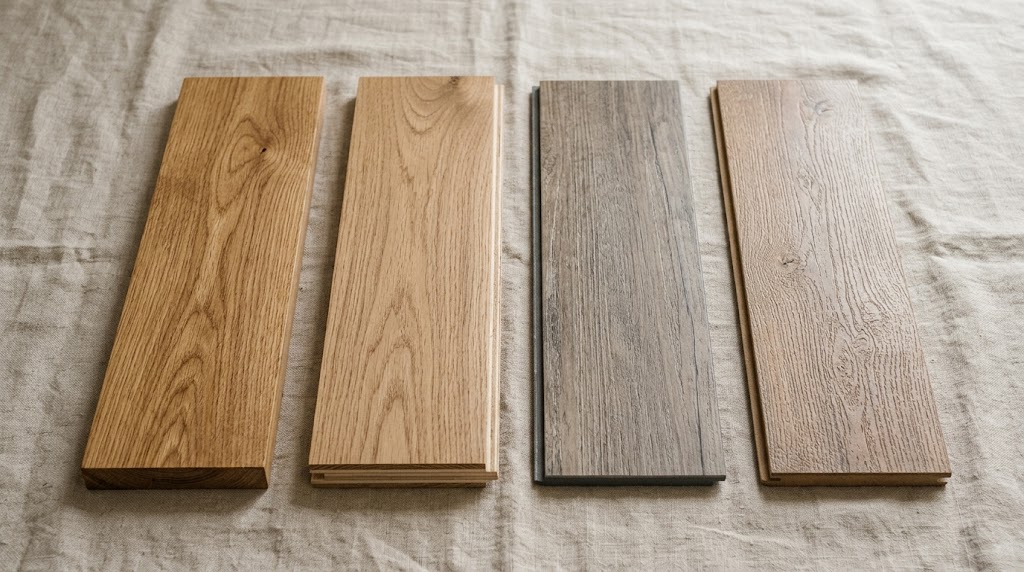
Flooring is the single largest surface decision in any residential or commercial build. Your choice shapes daily comfort, acoustics, maintenance costs, and resale value. While comparing engineered wood vs solid hardwood used to be the main decision, the 2026 landscape demands a wider view: stone plastic composite (SPC) and performance laminates now compete directly with timber for project specifications.
Whether you are a homeowner curating finishes, a developer managing multi-unit margins, or an importer vetting offshore shipments for US compliance, the wrong choice can mean moisture failures, blown budgets, or containers held at the port.
This guide breaks down the differences, installed costs, return on investment (ROI), and critical US import rules across all four hard-surface categories.
The 2026 Flooring Market in Numbers
Market data explains why certain materials dominate job sites — and where timber still commands a premium.
According to Grand View Research, the U.S. flooring market was valued at USD 35.80 billion in 2025 and is projected to reach USD 68.07 billion by 2035, a compound annual growth rate (CAGR) of 6.7%. Behind that growth sits a structural shift: Grand View Research reports that resilient flooring — a category covering luxury vinyl tile (LVT), SPC, and wood plastic composite (WPC) — captured approximately 67% of total U.S. flooring revenue in 2025.
Floor Covering News confirms the shift from the trade side: resilient flooring represented 36.5% of total U.S. flooring dollar sales in 2025, LVT generated more dollar sales than any other single flooring category, and rigid-core products (SPC and WPC) accounted for about 70% of LVT sales. Across the whole industry, Floor Covering News put total 2024 U.S. flooring sales at nearly USD 24 billion across more than 17 billion square feet of product.
| Market Metric | Recorded Value | Industry Source |
| U.S. flooring market (2025) | USD 35.80 billion | Grand View Research |
| Projected U.S. market (2035) | USD 68.07 billion (6.7% CAGR) | Grand View Research |
| Total U.S. industry sales (2024) | ~USD 24B across 17B+ sq. ft. | Floor Covering News |
| Resilient share of U.S. dollar sales (2025) | 36.5% | Floor Covering News |
| Rigid-core share of LVT sales (2025) | ~70% (SPC + WPC) | Floor Covering News |
| Global vinyl flooring (2025 → 2033) | USD 44.7B → USD 69.1B | Grand View Research |
| Asia-Pacific share of global vinyl (2025) | 43.5% (China largest single country) | Grand View Research |
| China PVC flooring exports (Jan–Feb 2026) | 715,000 tons (+3.1% YoY) | China Customs data |
The rigid-core boom has had growing pains. Floor Covering News reports that in 2025 WPC dollar sales rose 4.2% while SPC rose 2.9%, and the average SPC retail price slipped to about USD 1.61 per square foot as sellers cleared inventory. Reported field failures of thin, low-end imported SPC pushed some specialty retailers back toward higher-grade WPC and improved laminate.
On the supply side, Grand View Research values the global vinyl flooring market at USD 44.7 billion in 2025, heading for USD 69.1 billion by 2033. Asia-Pacific holds 43.5% of that market, with China the largest single manufacturing nation — and China Customs data shows PVC flooring exports of 715,000 tons in the first two months of 2026 alone, up 3.1% year-on-year.
The Four Contenders Explained
Choosing well means looking past the surface print to construction, dimensional behavior, and material limits:
| Material | Construction (top to bottom) |
| 1. Solid Hardwood | Single solid timber plank (oak, walnut, maple) |
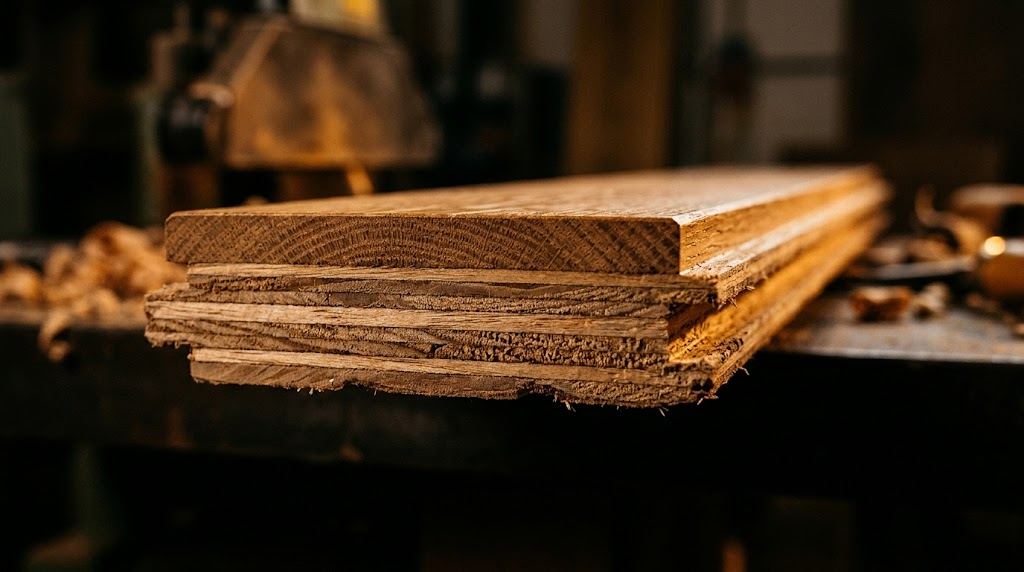
| 2. Engineered Wood | Real hardwood wear layer (lamella) over a cross-grain multi-ply plywood core |
| 3. SPC Rigid Core | UV-cured wear layer + decorative film over a limestone (CaCO₃) + PVC composite core, usually with attached acoustic underlayment (IXPE/EVA) |
| 4. Laminate | Aluminum-oxide protective overlay + high-resolution print layer over a high-density fiberboard (HDF) wood core |
Solid Hardwood
The traditional baseline. Each plank is milled from one continuous piece of lumber — most commonly white oak, red oak, maple, walnut, or hickory — typically 3/4-inch thick, with tongue-and-groove edges for nail-down installation over a wood subfloor.
- Strengths: Unrivaled longevity. Solid hardwood can be sanded and refinished across generations, with natural grain variation and an authentic feel underfoot.
- Weaknesses: Vulnerable to humidity swings. Solid timber expands and contracts across its grain, which can cause cupping or gapping. It cannot go directly over concrete and does not belong in basements.
Engineered Wood
Engineered wood solves solid timber’s moisture instability. A genuine hardwood wear layer (the lamella, from 1.2 mm to over 6 mm) is bonded to a core of cross-laminated plywood plies. Because adjacent plies run perpendicular, cross-grain tension cancels out the wood’s urge to swell or shrink.
- Strengths: Real hardwood looks with far better dimensional stability. It can be glued to cured concrete, nailed to wood subfloors, or floated over underlayment. Planks with thick wear layers can be refinished multiple times.
- Weaknesses: Wear layers under 2 mm cannot be sanded. And because the core is bonded with resins, uncertified off-spec imports can carry emissions and delamination risks — a point that matters later in this guide.
SPC Flooring (Stone Plastic Composite)
SPC is the “rigid core” branch of luxury vinyl. Pulverized limestone (calcium carbonate) is blended with PVC polymers under heat and pressure into a stone-dense synthetic core, topped with a high-definition print film, a ceramic-bead-reinforced wear layer, and usually an integrated acoustic backing (IXPE or EVA foam).
- Strengths: 100% waterproof — it will not swell, buckle, or rot in standing water, making it immune to basement dampness, pet accidents, and bathroom humidity. The dense core resists dents from heavy furniture and high traffic.
- Weaknesses: Firm and cool underfoot without underfloor heating. Subfloor imperfections can telegraph through or stress the click joints, and cheap thin formulations (under 4 mm) have a history of brittle locking tabs.
Laminate Flooring
Modern laminate is a synthetic-wood hybrid: a high-resolution photographic layer sealed under a melamine overlay with aluminum oxide, pressed onto a dense HDF core with a balancing backing layer.
- Strengths: Outstanding resistance to scratches, scuffs, and fading — often beating real timber against pet claws and active kids. Premium lines use embossed-in-register (EIR) textures that track the printed grain. Budget-friendly and fast to install.
- Weaknesses: The HDF core fears water. Wax-sealed edges buy you 24–72 hours against topical spills, but standing leaks or vapor pressure from below will swell the core and permanently damage the seams.
Head-to-Head Comparison Table
| Feature / Metric | Solid Hardwood | Engineered Wood | SPC Rigid Core | Performance Laminate |
| Plank Construction | 100% solid timber plank | Hardwood veneer over multi-ply core | Limestone composite + PVC core | Print layer + overlay on HDF core |
| Waterproof Rating | Low; warps and cups | Moderate; resistant top, vulnerable core | 100% waterproof | Moderate; topical resistance only |
| Typical Installed Cost | $6–25 / sq. ft. | $6–25 / sq. ft. | $3–18 / sq. ft. | $3–13 / sq. ft. |
| Average Lifespan | 50–100+ years | 25–40+ years | 15–25 years | 15–25 years |
| Refinishable? | Yes (4–7+ sanding cycles) | Yes, if wear layer ≥3 mm (1–3 cycles) | No (replace planks) | No (replace planks) |
| Primary Installation | Nail/staple to wood subfloor | Glue-down, nail, or float | Floating click-lock | Floating click-lock |
| Best Room Applications | Living areas, dining, bedrooms | Main floors, slabs, dry basements | Kitchens, baths, basements, rentals | Living areas, rentals, bedrooms |
| Resale Market Impact | Highest buyer demand | High positive impact | Neutral to moderate | Neutral |
Cost, Lifespan and Resale ROI: Engineered Wood vs Solid Hardwood and Alternatives
Project budgets must weigh upfront cost against maintenance cycles and resale value.
Installed Costs per Square Foot
According to home-services cost data from Modernize, typical installed costs fall into clear tiers:
- Solid and engineered hardwood: $6–25 per square foot. Premium species, thick wear layers, and glue-down labor sit at the top.
- Resilient (LVP/SPC): $3–18 per square foot. Floating click installation keeps labor low.
- Laminate: $3–13 per square foot — the most accessible hard-surface entry point.
- For reference, ceramic and porcelain tile runs $10–31 per square foot installed.
Durability, Lifecycles, and Maintenance
Solid hardwood’s premium balances out over decades: a 3/4-inch profile leaves ample wood above the tongue for repeated sanding and re-staining.
Engineered wood balances durability with flexibility. A 3–6 mm wear layer can be refinished one to three times and last 25 to 40 years with proper care; veneers under 2 mm can only handle a light screen-and-recoat.
SPC and laminate cannot be refinished — damaged boards are unclicked and replaced. Their scratch resistance often beats wood on day one, but working life caps at roughly 15 to 25 years.
Resale Returns
Real wood’s financial return remains unique. According to the National Association of Realtors (NAR) 2025 Remodeling Impact Report, refinishing existing hardwood floors recovers an estimated 147% of project cost at resale — and earned a perfect 10 “Joy Score” from surveyed homeowners.
Industry survey data shows roughly 54% of prospective buyers would pay a premium for a home with real hardwood, and hardwood installations typically recapture 70–80% of their cost at resale. SPC and laminate are excellent for rentals and budget flips, but rarely lift appraisals on mid-to-high-end homes the way real wood does.
Importing Flooring? The Compliance Checkpoint Nobody Tells You About
For contractors and builders sourcing containers directly from offshore manufacturers, pricing is only half the battle. Compliance at the port of entry is an absolute checkpoint.
Under the U.S. Environmental Protection Agency’s (EPA) Toxic Substances Control Act (TSCA) Title VI (40 CFR Part 770), formaldehyde emissions from composite wood products are federally regulated — covering hardwood plywood (HWPW), particleboard (PB), and medium-density fiberboard (MDF, including thin MDF), whether imported as raw panels or as cores inside finished goods.
The Composite Core Trap
- Engineered wood flooring has a hardwood-plywood-type core — it is regulated. Since March 22, 2024, non-exempt laminated products (wood veneer pressed onto composite cores) must be certified as hardwood plywood.
- Laminate flooring runs on an HDF core — it is regulated under the MDF/thin-MDF limits.
- Solid hardwood and pure SPC are exempt. Solid lumber contains no composite core; pure SPC is an inorganic limestone-PVC matrix with zero composite wood. That exemption is one reason imported SPC moved through ports so quickly.
| Product Category | TSCA Title VI Status | Core Classification | Max Formaldehyde Limit |
| Solid Hardwood | Exempt | 100% natural lumber | N/A |
| SPC Flooring | Exempt | Limestone (CaCO₃) + PVC | N/A |
| Engineered Wood | Regulated | Hardwood plywood core | 0.05 ppm |
| Laminate Flooring | Regulated | MDF / thin MDF core | 0.11 / 0.13 ppm |
| Particleboard Core | Regulated | Particleboard platform | 0.09 ppm |
The caps match California CARB ATCM Phase II: hardwood plywood 0.05 ppm, particleboard 0.09 ppm, MDF 0.11 ppm, thin MDF (≤ 8 mm) 0.13 ppm.
Meeting the caps is only half the requirement. Since March 22, 2019, composite wood products made in or imported into the US must be certified by an EPA-recognized Third-Party Certifier (TPC) and carry a physical “TSCA Title VI compliant” label. Legacy CARB Phase 2 paperwork alone no longer satisfies federal entry rules.
US importers carry direct legal accountability: you must certify compliance at entry and keep an unbroken audit trail — invoices, bills of lading, supplier compliance statements — for at least three years. Non-compliant shipments risk refused entry, seizure, and significant civil penalties.
Note: Import rules, tariff codes, and testing standards change. Confirm current requirements with the US EPA or your licensed customs broker before signing import agreements.
Which Floor for Which Room
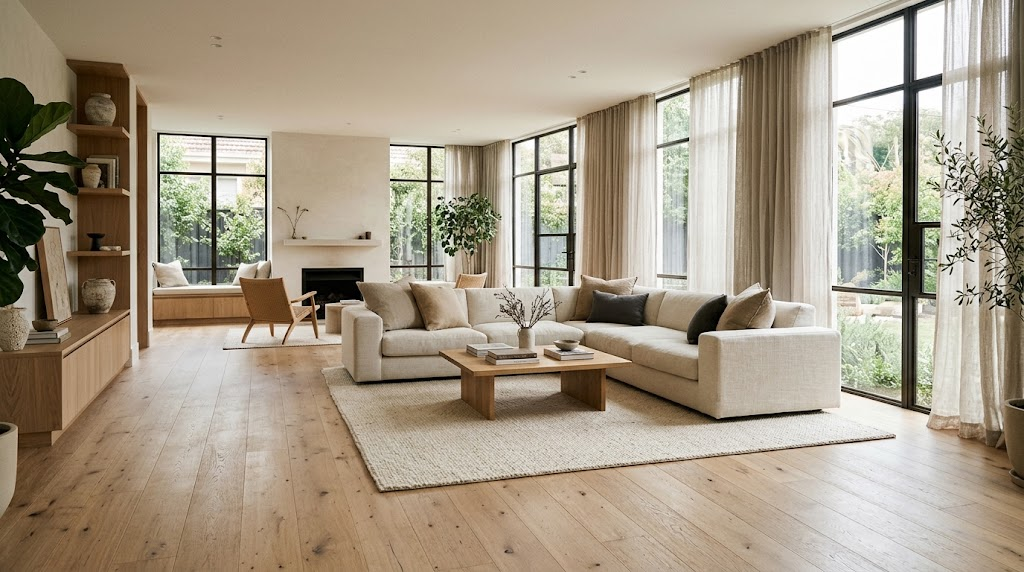
No single material wins every room. Match the floor to the environment:
Upper floors / quiet zones
- Bedrooms: solid hardwood, engineered wood, or laminate (acoustic comfort matters most)
Main level
- Kitchen: 100% waterproof SPC (spill and drop protection)
- Living / dining: engineered wood or solid hardwood (visual prestige and ROI)
- Powder room: SPC or glazed ceramic tile
Below grade / wet zones
- Full baths & laundry: waterproof SPC
- Basements / concrete slabs: SPC, or high-spec engineered wood in dry conditions
High-turnover rentals and multi-family
- Performance laminate (abrasion resistance, fast turnover) or SPC where spills may sit unattended
Sourcing Flooring from China: A Quick Checklist
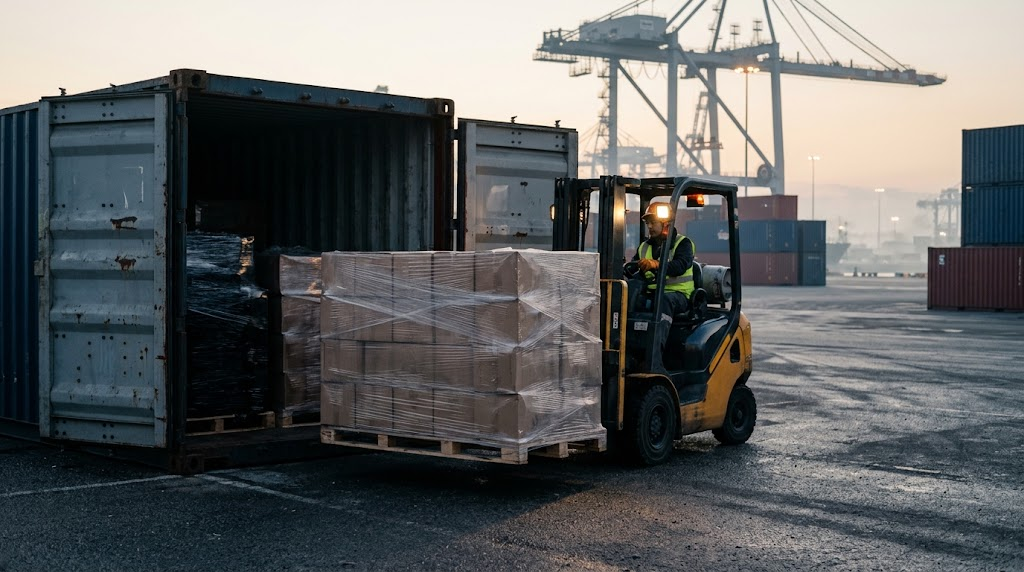
Buying direct from China gives developers and contractors access to advanced manufacturing, custom profiles, and bulk economics — but it demands a disciplined vetting protocol:
- Validate TPC accreditation: for engineered wood or laminate, confirm the mill’s Third-Party Certifier is EPA-recognized, and request current certificates with verifiable lab codes.
- Pin down wear layers: for engineered flooring, specify veneer cut (rotary, sliced, or dry-sawn) and exact millimeter thickness; for SPC, specify wear-layer mils (e.g., 20 mil / 0.5 mm for commercial), not just total plank gauge.
- Audit core chemistry: for SPC, confirm the limestone-to-virgin-PVC ratio; virgin cores stay flexible and keep locking tabs from going brittle.
- Check locking tolerances: verify the click profile engages smoothly and seam tolerances hold across a full floating installation.
- Consolidate shipments: a flooring-only run often leaves containers half full. Bundling flooring with cabinetry, doors, and finishes through one supply partner cuts freight cost per item and simplifies management.
Partner with George One-Stop Furnish
Navigating materials, production timelines, and export compliance takes experienced coordination. At George One-Stop Furnish, we bring 20 years of specialized manufacturing experience, with finishes delivered for over 30,000 housing projects — villas, apartment complexes, hotels, and resorts — and more than 80,000 clients worldwide.
From our 20,000+ m² showroom in Foshan, China, we supply premium solid hardwood, precision-milled engineered wood, waterproof SPC, and performance laminates — integrated with our custom cabinetry, doors and windows, sanitary ware, and tile collections in one whole-house package.
Our in-house team provides free CAD, 2D, and 3D design services, aligning flooring selections with your plans, backed by end-to-end export support: factory quality assurance, container shipping, customs documentation, and after-sales service.
Ready to specify flooring for your next project? Send us your floor plans and schedules today for a free, itemized quotation — and order a physical sample pack shipped to your desk.
Sources
- Grand View Research: U.S. Flooring Market Size, Share & Trends Analysis Report (2025–2035); Vinyl Flooring Market Size, Share & Trends Analysis Report (2025–2033)
- Floor Covering News (FCNews): Annual flooring industry statistics and market reports (2025/2026 editions)
- National Association of Realtors (NAR): 2025 Remodeling Impact Report
- US EPA: TSCA Title VI (40 CFR Part 770) — Formaldehyde Standards for Composite Wood Products
- California Air Resources Board (CARB): ATCM Phase II
- General Administration of Customs of China: PVC flooring export volume data (Jan–Feb 2026)