
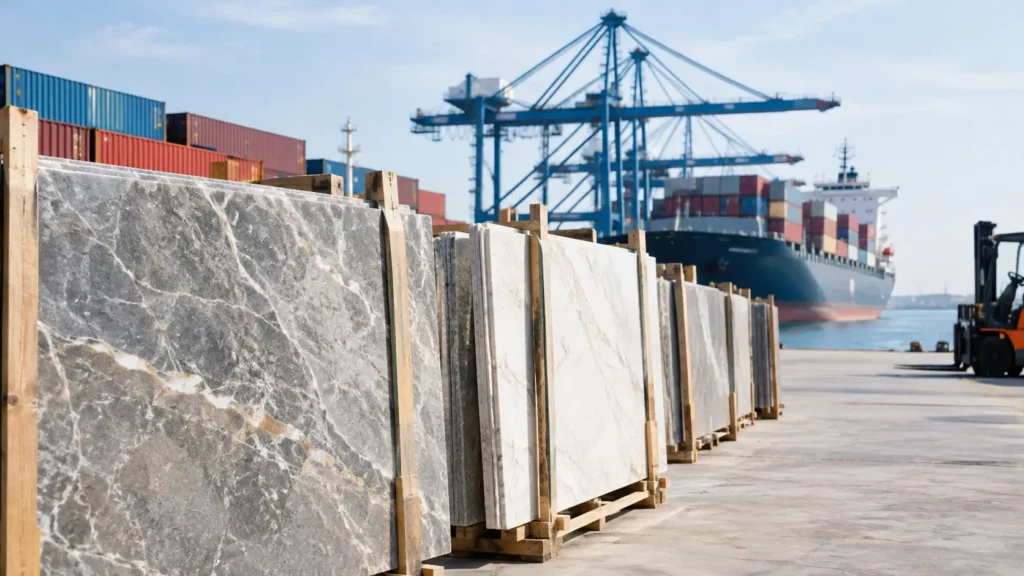
A full container of stone from China rarely lands at the factory quote. Realistic all-in figures usually run 40–70% above the FOB price once freight, duties, insurance, and fees stack up.
So how much does it cost to import stone from China? There’s no single number. The cost swings with stone type, quantity, product form, container size, freight rate, port, and HTS code. Anyone quoting one flat figure is guessing.
If you want to import stone from China without surprises, you need the complete landed cost. That landed cost has five layers: product, freight, duties, insurance, and miscellaneous. Your final number depends on all five. The supplier’s unit price is just the start. Knowing how to import stone from China means tracking every layer, since each one adds to your import cost.
Key Takeaways
- The final cost to import stone from China is usually 40-70% higher than the factory quote.
- Five main costs add up: product, freight, duties, insurance, and hidden fees.
- Duties and tariffs stack — Section 301 alone adds 25% on top of the base rate for most Chinese stone.
- You can lower costs by buying full containers, comparing freight rates, and checking HTS codes.
- Always ask for itemized quotes and budget a 10-15% buffer for unexpected changes.
Cost to Import Stone from China: Product Pricing
Granite and Stone Price Ranges
Granite exported from China typically ranges from USD 18–60 per square meter FOB. That spread covers a lot of ground. Color, thickness, processing, and order volume all move the number. A basic gray slab at 2cm sits near the bottom. A rare black or exotic red at 3cm with a polished face pushes toward the top.
Other stone types sit in different ranges. At the factory gate, 2cm slabs price out like this:
| Material | FOB China Price Range (USD/m², 2cm slab) |
|---|---|
| Marble (Carrara, commercial) | $45 – $90 |
| Marble (Carrara, select/premium) | $90 – $160 |
| Marble (Calacatta, commercial) | $120 – $220 |
| Marble (Calacatta Gold, premium) | $200 – $400+ |
| Marble (Chinese-origin, e.g., Guangxi White) | $25 – $50 |
| Marble (Panda White, China) | $40 – $80 |
| Quartzite | $50 – $120 |
Grade, finish, and volume move every one of those numbers. Honed and brushed faces cost more than raw sawn surfaces. Polished premium slabs can double the entry price.
What Drives Factory Prices
Several factors push the FOB quote up or down. The type and quality of the raw stone matter first. Origin and rarity come next. Slab dimensions and panel sizes affect yield. Manufacturing efficiency and technological complexity shape the labor side. Supply chain logistics and transportation costs feed in too. Environmental compliance adds another layer. Order volume is the lever you control — bulk discounts range from 5% to over 20% off list price. Material texture tier matters as well, with entry-level slate and quartzite sitting far below premium marble and translucent varieties. Shipping destination and freight terms, usually standard FOB Shanghai, round out the list.
One warning before you compare quotes: the FOB unit price is only the starting point: the FOB unit price is only the starting point. Shipping, tariffs, and fees will significantly increase your total landed cost. According to the Natural Stone Institute, the Section 301 tariff on dimensional stone from China added 15 to 25 percent to the landed cost of affected products. That shift pushed significant specification volume toward alternatives from Brazil, Turkey, and India.
When a supplier quotes material not yet imported, or quotes FOB from an overseas source, the tariff may not be listed separately — or at all. It can surface at customs as an unbudgeted cost. The risk concentrates on direct import orders, large project orders where the contractor arranges freight, and suppliers quoting FOB origin terms from overseas warehouses.
Haven’t shortlisted suppliers yet? Start with our guide on how to find reliable stone suppliers in China — vetting the right factory matters more than negotiating the last dollar.
How to Import Stone from China to the USA: Freight and Logistics
Sea Freight and Container Rates
Ocean freight is the dominant cost after the product itself. Rates move with fuel prices, peak season, and carrier capacity. That’s why a quote from three months ago may not hold today.
Container choice matters a lot for heavy stone. Granite’s density means weight limits hit before volume does. Both a 20ft and a 40ft container share the same maximum gross weight of 30,480 kg (67,200 lbs). But the 40ft box has a heavier steel frame, so its allowable cargo payload drops by roughly 1,450 kg (over 3,000 lbs). For dense slabs, the 20ft container is the more weight-efficient choice.
That said, the 40ft box still carries nearly double the granite payload. Its ocean freight cost runs only 20–35% more, not 100% more. So the cost per tonne drops sharply. Volume buyers with steady throughput usually win with 40ft containers.
US DOT gross vehicle weight limits cap at 80,000 lbs, with over 50% of overweight violations traced to axle-weight breaches rather than total weight. A 20ft container’s shorter chassis concentrates cargo weight over fewer axles — an advantage when shipping dense materials like steel or stone that could trigger axle violations on a longer 40ft trailer. (Source: Oversize.io, “Overweight Container Guide for US Roads,” 2024–2025.)
Port Charges and Inland Transport
Destination port charges add up fast. You’ll pay terminal handling, then drayage to the first stop. Drayage is the truck move connecting the ocean leg to your warehouse, usually under 100 miles. The work is in the details: terminal appointments, chassis supply, container weight against road limits, and the free time clock at the terminal.
Drayage rates vary by port:
| US Port | Typical Drayage Range (port to first stop) |
|---|---|
| Long Beach / Los Angeles | $300–$800 |
| Seattle / Tacoma | $350–$900 |
| Savannah | $250–$600 |
| Newark / New York | $400–$1,200 |
| Houston | $300–$700 |
| Norfolk | $250–$650 |
Inland trucking depends on distance. A 200-mile haul runs $600–$1,000 per container. At 800 miles, expect $2,500–$4,000. Between 300 and 500 miles, compare quotes — rail may save 10–15%. Over 500 miles, rail usually wins, cutting 30–50% off trucking.
Watch the clock, too. Demurrage after free time runs $75–$150 per day for days 1–5, then $150–$250 per day from day 6 onward. Chassis rental adds $30–$60 per day. These fees quietly raise your landed cost.
Import Duties and Taxes on Stone from China
You’ve locked in product pricing and freight. Now comes the layer that catches many buyers off guard: duties and taxes. Import duties & hs codes determine what you actually pay at the border. U.S. customs duty on building materials from China ranges from 25% to over 100% for some categories. Your complete landed cost depends on getting this classification step right.
Tariffs, Section 301, and HTS Codes
The duty picture has several moving parts, not just one. Your total includes the base Column 1 rate, plus Section 301 additional tariffs, plus ad valorem processing fees. Each component stacks on the last.
Your HTS classification determines which rates apply, and different codes trigger very different totals. Here is the breakdown for worked granite, HTS 6802.93.00.00:
| Program | HTS Heading | Rate | Duty Amount (on $10,000) |
|---|---|---|---|
| General rate of duty (Column 1) | 6802.93.00.00 | 3.7% | $370 |
| Section 301 China (List 3) | — | 25% | $2,500.00 |
| Effective duty rate | — | 28.7% | $2,870.00 |
Note: rates current as of Q3 2026. Confirm your exact code and rate at hts.usitc.gov or with your broker before budgeting — Section 301 product lists have changed before and can change again.
A 28.7% effective rate is more than double what most first-time buyers expect at the border. On a $10,000 shipment, you pay $2,870 in customs duty alone.
Common HTS codes for stone include 6802 (worked monumental or building stone) and 6810 (articles of concrete or artificial stone). Each code carries its own rate structure, and misclassification is expensive: you either overpay duty or face penalties in a CBP audit. Have your customs broker confirm the code in writing before you wire the deposit.
The additional china tariffs under Section 301 apply to nearly all Chinese stone imports. The section 301 duty on List 3 adds 25% on top of the base rate. Additional Section 301 measures may apply to certain product codes — verify yours before ordering. These duty rates stack, they do not replace each other. A wrong code can also hold your container at the border for weeks, so make sure the classification on your entry documents matches the physical product exactly.
Customs Clearance and Broker Fees
Beyond duty rates, processing fees hit every entry. The Merchandise Processing Fee (MPF) applies to all formal entries. As of October 1, 2025, the rate is 0.3464% of entered value.
| Effective Date | Ad Valorem Rate | Minimum | Maximum |
|---|---|---|---|
| 10/1/2025 | 0.3464% | $33.58 | $651.50 |
On a $10,000 shipment, MPF runs $34.64. The Harbor Maintenance Fee (HMF) adds 0.125% on cargo value for seaport entries. These customs duties and fees apply to every container when you import stone from china to the usa.
Customs broker fees run $100–200 per entry. That covers filing, classification work, and CBP communication. Customs entry fees add another $100–200 per shipment. Together, these total $200–500 per container before the duty itself. Understanding tariffs and duties before you buy prevents budget surprises. The stone import tariffs landscape has shifted dramatically since 2018, and staying current matters.
The U.S.-China trade war reshaped the stone market. Additional China tariffs reduced Chinese supply. Many buyers shifted sourcing to Brazil, Turkey, and India. But some stone varieties are unique to China, and the tariffs and duties on those products drive landed cost up substantially.
Base rates, Section 301 additions, MPF, and HMF all stack on each other. For a $10,000 shipment of worked granite, you might pay $3,000+ in total duties and fees. Your budget has to account for every single component. When you calculate the total cost to import stone from china, duties often make up the difference between profit and loss.
Cargo Insurance and Compliance Costs
Insuring Heavy, Fragile Stone
Stone is heavy and breaks easily, which makes cargo insurance non-negotiable. Standard policies often exclude fragile items unless they’re professionally packed. Without coverage, a cracked slab shipment becomes your loss, not the carrier’s.
Premiums are calculated as a percentage of CIF value. Standard goods might run 0.3–0.5% of the insured amount, but fragile cargo pays higher rates. Deductibles shift more cost to you. Underinsurance penalties apply when your claim gets compared to the declared value. Marine cargo insurance also demands more than a certificate. You need shipment identity, agreed value basis, pre-shipment condition records, package traceability, notification contacts, arrival evidence, and a separate project disposition record. Without these records, a breakage claim may be delayed or denied — a second loss on top of the first.
Inspection, Testing, and Documentation
Documentation and compliance fees run $50–100 per shipment. That covers paperwork, certificates, and filing. Inspector, lab testing, and QA/QC expenses may apply when importing building materials from China. These costs vary by product and buyer requirements.
If CBP or the USDA selects your container for examination, the buyer pays. A Centralized Examination Station (CES) exam — devanning, inspection, and restuffing — typically adds $300–$800 to your clearance costs. Port storage, re-export costs, mandatory treatment, and project delays can follow. Thorough documentation reduces the odds of examination, but selection is risk-based — it cannot be eliminated.
Every one of these charges feeds your final cost — and skipping compliance always costs more than doing it right.
For the full pre-shipment QC workflow — samples, slab photos, third-party inspections — see Sourcing Stone from China: A Buyer’s Guide.
Hidden Costs to Import Stone from China
Currency Exchange and Payment Fees
The factory quote never mentions what your bank charges. Currency exchange spreads, wire transfer fees, and letter-of-credit charges all add to your import cost. These fees vary by payment method, and some carry hidden mark-ups that don’t show up until the money leaves your account.
| Payment Method | Hidden Costs (Currency Exchange & Payment Fees) |
|---|---|
| Cash | Requires foreign exchange transaction; exchange rate mark-ups in addition to stated fees. |
| International credit/debit cards | High fees passed on by supplier; cost-prohibitive for buyers. |
| Letters of Credit (LCs) | Very high fees; complex paperwork adds cost. |
| PayPal | Fees charged as percentage; substantial exchange rate costs; expensive for large orders. |
| Western Union | Low published fees but hidden currency exchange mark-up (not shown in online calculator); overall cost higher due to poor exchange rate. |
| Sourcing agencies | Adds another layer of expense (agency fees). |
Wire transfers look cheap on paper. The exchange rate spread tells a different story. Western Union advertises low fees, yet the currency mark-up stays hidden from the online calculator. Letters of credit carry very high fees plus complex paperwork. Every one of these charges lands before the stone does.
Warehousing and Last-Mile Handling
Storage fees start the moment your container leaves the port, and the demurrage clock covered above keeps ticking while clearance drags.
Last-mile handling covers unloading, palletizing, and moving slabs into your warehouse. Buyers often forget this step when they calculate the cost to import stone. The Eonyx guide notes that port fees, customs clearance, and inland transport deserve attention, and that duties vary by stone type. Those overlooked items push the total well above the original quote. Budget a buffer, track every fee, and the final number stays predictable when you import stone from china.
So how much does it cost to import stone from china? Stack all five layers — product, freight, duties, insurance, and hidden fees — and a full container usually lands 40–70% above the factory quote. That’s your realistic range.
You can shrink that cost. Consolidate shipments, negotiate Incoterms, compare freight forwarders, and verify HTS codes before you buy. Full-container volumes lower your unit cost too.
Always request itemized quotes. Build a 10–15% buffer for freight swings and duty changes. A careful landed-cost calculation protects your margin. Skip it, and your estimated landed cost becomes a guess. Budget the landed cost, and the factory quote stops being a surprise.
Landed Cost Example: 450 m² of G603 Granite to Los Angeles
Here’s what one recent order actually cost, door to warehouse:
| Cost Layer | Amount (USD) |
| Product — 450 m² G603, 2cm polished, FOB Xiamen @ $24/m² | $10,800 |
| Ocean freight — 1 × 20ft, Xiamen → Los Angeles | $2,800 |
| Duty — HTS 6802.93, effective 28.7% of entered value | $3,100 |
| MPF (0.3464%) + HMF (0.125%) | $51 |
| Customs broker + entry fees | $150 |
| Cargo insurance (~0.5% of CIF) | $68 |
| Drayage — LA port to warehouse | $500 |
| Total landed cost | $17,469 |
| Landed cost per m² | $38.8/m² |
That is 62% above the factory quote — right inside the 40–70% range from the start of this guide. The same stone retails domestically at $55–75/m², which is why the math still works. But only if you budget the full landed cost, not the FOB price. (Freight and duty rates as of Q3 2026 — verify both before you commit.)
Planning a stone order? Send us your material list and destination port — we’ll come back with an itemized landed-cost quote, including duty verification for your HTS codes.
FAQ
What’s the real total cost for a full container of stone?
Expect 40–70% above the factory quote once everything stacks up. Product, freight, duties, insurance, and hidden fees all add to that number. A $10,000 shipment of worked granite can carry $2,870 in duty alone. Budget a 10–15% buffer on top for freight swings and tariff changes.
Why is my final bill so much higher than the supplier’s quote?
The FOB price covers layer one of five. Freight, Section 301 tariffs, MPF, HMF, broker fees, and drayage all land later. A 28.7% effective duty rate on worked granite surprises plenty of buyers. Request itemized quotes upfront so nothing shows up unannounced at customs.
Should I ship stone in a 20ft or 40ft container?
It depends on weight. Both boxes share a 30,480 kg gross limit, but the 40ft frame is heavier, so payload drops by roughly 1,450 kg. Dense granite often maxes out a 20ft box first. A 40ft container costs only 20–35% more in ocean freight, so cost per tonne falls.
How much will duties and tariffs actually cost me?
That depends on your HTS code. Worked granite under HTS 6802.93 currently carries a 28.7% effective rate once Section 301 stacks on the base rate. Wrong classification means overpaying or facing penalties.
What’s the easiest way to cut my landed cost?
Buy in full-container volumes and consolidate shipments. Compare freight forwarders instead of accepting the first rate. Negotiate Incoterms so you control the freight leg. Verify HTS codes before you buy. Those four moves shrink every layer of your total cost.