
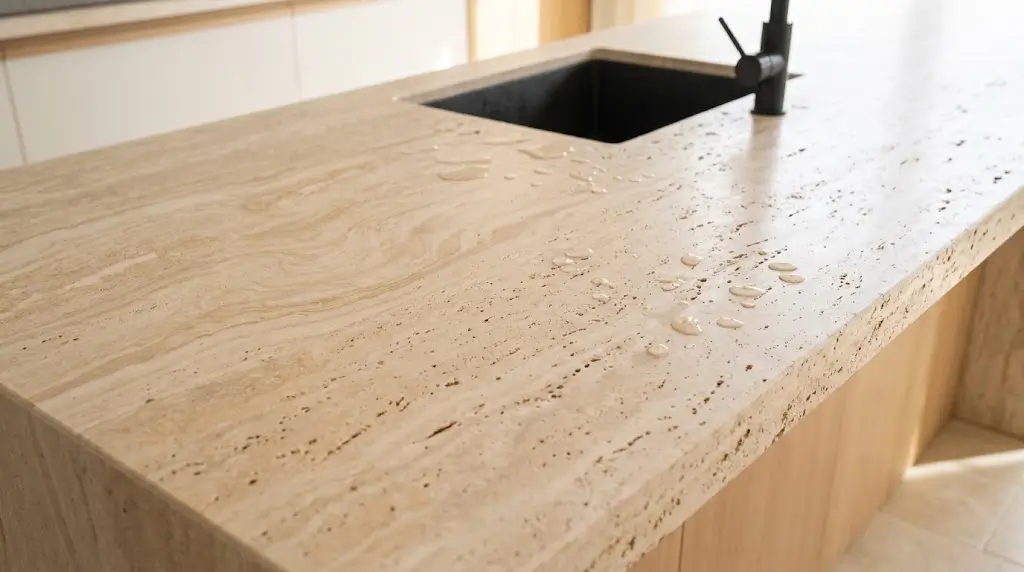
Travertine countertops bring the elegance and warm, organic texture of classic European masonry straight into modern spaces. For those looking to achieve a soft, luxurious aesthetic without the premium price tag of high-end marble—which often exceeds $180 per square foot—slab travertine offers a compelling alternative at roughly $75 per square foot.
However, this natural beauty requires a practical mindset. Because travertine is inherently porous, it demands routine protective sealing to defend against deep liquid stains and acidic etching. When properly maintained, this versatile stone delivers decades of durable daily performance, making it a high-value investment for both custom residential kitchens and commercial architectural projects.
Wichtigste Erkenntnisse
- Travertine offers warm natural stone beauty at a lower price than marble.
- Filled travertine slabs create smooth surfaces that keep kitchen food prep areas clean.
- Honed finishes hide minor scratches and acid marks better than shiny polished surfaces.
- Mild freeze-free climates suit outdoor travertine, but freezing weather causes severe surface cracking.
- Routine sealing every two years protects porous stone surfaces from dark liquid stains.
Travertine Countertops Buyer’s Guide
This buyer’s guide provides clear facts to help homeowners evaluate Naturstein options for modern living spaces. Selecting material for custom kitchen surfaces requires careful evaluation of aesthetics, practical maintenance, and long-term durability.
Pros and Cons for Homeowners
Every surface material presents trade-offs for daily kitchen activities. Evaluating these pros and cons helps property owners make practical design decisions. Travertine countertops offer distinct aesthetic charm with warm organic textures. However, their physical features differ noticeably from synthetic surfaces like quartz.
| Property | Travertin | Quarz |
|---|---|---|
| Stain resistance | Poor: spills, especially acidic liquids such as lemon or orange juice, can cause permanent damage | High: highly stain resistant and does not require sealing |
| Scratch resistance | Soft physical surface requires protective handling | High general resistance against surface scratches |
| Heat tolerance | Natural stone body withstands high temperatures well | Poor: hot cookware can melt resin and leave permanent marks |
High-quality travertine instantly elevates a kitchen’s aesthetic. The trade-off? Its natural pores are highly vulnerable to acidic spills like lemon juice or wine. While alternatives like quartz offer superior stain resistance without the need for sealing, they fall short in heat tolerance—a hot pan can permanently scorch their resin binders.
Core Features of Travertine Stone
Understanding the physical structure of travertine stone allows homeowners to select the best material grade. Naturally formed over centuries around mineral springs, this rock contains interconnected void spaces. Filling these voids during production reduces porosity and creates smooth worktops for everyday food preparation.
| Physical property | Reported value | Conversion / note |
|---|---|---|
| Porosity (natural) | 5–15% | Filling reduces effective porosity |
| Mohs hardness | 3–5 | Softer than granite; moderate wear resistance |
| Density | 2.3–2.68 g/cm³ | ~143.6–167.3 lb/ft³ |
Selecting raw stone requires attention to structural density and solid surface uniformity. Choosing a good quality travertine ensures high physical density around 2.3–2.68 g/cm³ (143.6–167.3 lb/ft³). The natural stone features a Mohs hardness rating of 3–5, which provides moderate wear resistance in residential installations.
Types of Travertine Stone and Finishes
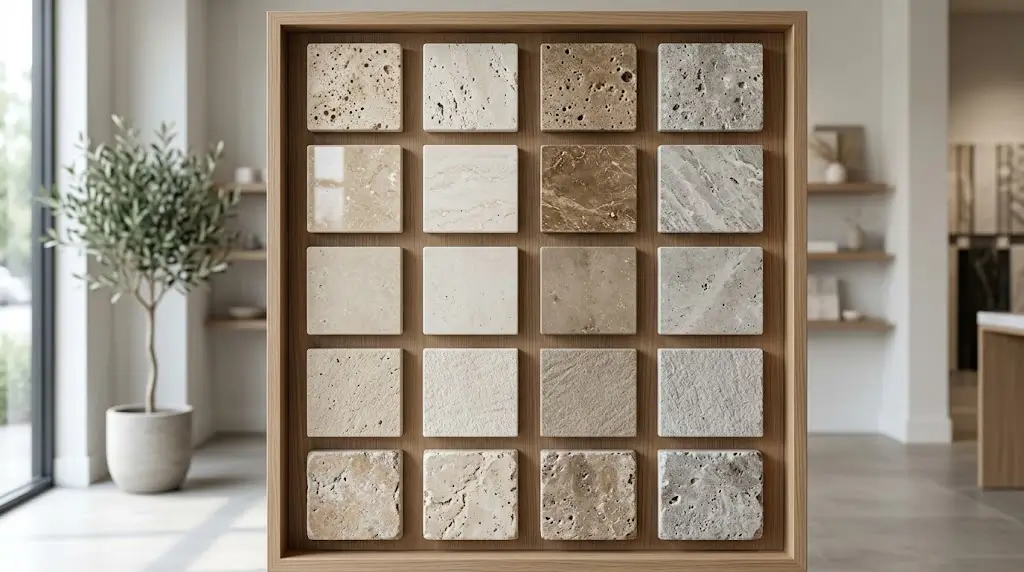
Selecting natural surfaces requires exploring different options with travertine stone for your residential remodel project. Each unique surface variation provides distinct practical benefits and visual characteristics. Homeowners analyze various types of travertine based on routine maintenance needs. Homeowners customize living spaces by selecting specific types of travertine finishes and formats.
Filled vs. Unfilled Travertine Stone
Raw travertine stone naturally features open voids and cavities on its surface. Manufacturers create filled travertine stone by filling these hollow spaces during fabrication. Factory workers commonly apply Portland cement or synthetic epoxy resin into the natural holes before smoothing the surface. Factory epoxy filler offers higher physical strength than Portland cement, which can stain or loosen under daily kitchen use.
The choice between filled and unfilled stone directly impacts daily kitchen hygiene. Unfilled travertine leaves its natural cavities fully exposed—creating prime catch-all spots for liquids, dirt, and bacteria. Because of this risk, filled slabs are the absolute standard for food preparation zones. Even though the stone retains a natural microscopic porosity of 2–12%, factory fillers effectively seal the largest surface voids, transforming a highly porous rock into a cleanable, sanitary worktop.
| Aspekt | Filled Travertine | Unfilled Travertine |
|---|---|---|
| Surface and Porosity | Factory filler closes open voids for a smooth touch | Open voids remain visible and absorb liquid directly |
| Stain Resistance | Less likely to trap food crumbs or dirty moisture | Open pockets collect food debris and require extra cleaning |
| Food Prep Use | Recommended for hygienic meal preparation areas | Not recommended for food prep due to trapped bacteria |
Honed, Polished, and Tumbled Options
Surface finishes determine how worktops handle regular physical wear and chemical exposure. Processing raw travertine slabs into finished boards involves different grinding techniques. Homeowners select smooth finishes when buying travertine slabs for their home improvement projects. Comparing different types of travertine helps buyers choose the ideal texture for specific rooms or decorative natural stone features.
Honed travertine offers a soft matte appearance without reflective shine. Acid contact from lemon juice or vinegar creates etch marks on natural surfaces. However, etching appears much less visible on honed finishes because the surface lacks high reflection. Minor physical scratches also blend smoothly into the flat background. This makes honed finishes popular for active residential kitchens.
Polished travertine features a mirror-like high-gloss finish. Bright surface reflections highlight the natural color variations of the material. However, acidic spills quickly leave dull smears that catch light and show immediate wear. Bright scratch lines stand out against the mirror surface. Therefore, polished material fits best on low-traffic decorative counters or bathroom walls.
Tumbled travertine provides a rough textured finish that offers maximum slip resistance. Fabricators tumble small pieces inside rotating drums with water and gravel. This process rounds sharp edges and creates a rustic surface.
- For outdoor kitchen countertops, select tumbled or brushed finishes because textured surfaces resist slipping.
- Avoid polished surfaces outdoors because moisture creates dangerous slip hazards.
- Apply an outdoor-rated penetrating sealer to protect against weather cycles.
Vein Cut vs. Cross Cut Selection
Understanding Slicing Techniques
Quarry workers harvest natural stone blocks and cut them using two primary directional methods. The chosen cutting angle changes the visual pattern and structural layer orientation of finished travertine slabs. Fabricators produce vein cut travertine slabs by slicing vertically against the sedimentary layers. This precise cut exposes distinct edge layers and creates long parallel lines running across the surface. Installers frequently use bookmatched layouts to align these rhythmic linear bands across large kitchen islands.
Conversely, fabricators produce cross cut stone by slicing horizontally along the natural sedimentary bedding plane. Slicing directly along the flat layer exposes subtle surface patterns that resemble soft cloudy swirls. Homeowners compare different types of travertine cuts to achieve specific visual effects in living spaces. Choosing a good quality travertine ensures uniform structural strength across the surface regardless of the slicing method.
| Merkmal | Vein Cut Travertine | Cross Cut Travertine |
|---|---|---|
| Visual appearance | Long parallel lines running the length of the slab | Cloud-like swirls with less directional movement |
| Structural slicing | Block cut vertically against sedimentary layers | Block cut horizontally along sedimentary layers |
| Countertop consideration | Clean contemporary lines; acid-sensitive to lemon and wine | Calmer look for continuous surfaces; acid-sensitive |
Popular Color Varieties
Mineral deposits naturally tint travertine into a wide spectrum of earthy hues, offering immense design flexibility. Classic beige and soft ivory remain timeless staples for traditional kitchens, while silver and cool grey slabs fit perfectly into modern aesthetics. For a more grounded, rustic feel, warm walnut and rich gold tones provide incredible visual depth. Ultimately, the goal is to pair these organic variations seamlessly with surrounding cabinetry and flooring—just remember that regardless of the color selected, routine sealing is mandatory to protect the finish.
Cost Analysis and Installation Budgeting
Material and Fabrication Costs
Planning a kitchen renovation requires a clear understanding of financial investments. Homeowners must evaluate material expenses and labor fees carefully during initial project planning. Purchasing high-quality stone represents the first essential step in estimating your total remodeling budget. Unfinished stone prices vary depending on slab origin, surface processing, thickness, structural density, and color rarity.
| 2025 estimate for travertine countertops | Cost per sq. ft. |
|---|---|
| Overall total installed cost (including fabrication/installation) | $45–$100 |
| Slab material | $25–$60 |
| Fabrication and installation | $20–$40 |
| Sealing/finishing | $2–$5 |
Beyond the raw slab, fabrication and installation represent a significant portion of the budget. This phase covers precision cutting, shaping custom edge profiles, and templating sink cutouts. For large layouts like expansive kitchen islands, skilled masons must carefully bookmatch the natural patterns to create visually seamless joints. By understanding how these specialized labor and transportation costs break down, buyers can budget accurately and avoid unexpected contractor fees.
Travertine vs. Marble and Granite
When balancing visual appeal with the overall project budget, travertine stands out as a highly competitive option. It delivers the luxurious, classic European aesthetic of high-end marble but at a fraction of the market price. While granite offers unbeatable scratch resistance, it simply cannot replicate the soft, organic warmth of natural limestone.
However, the initial financial savings must be weighed against structural realities. Because travertine is significantly softer than granite, fabrication requires specialized care from your installers. For the end-user, achieving that premium look at a practical price point means committing to regular maintenance. By understanding these trade-offs upfront, buyers can secure a high-end architectural finish that performs beautifully for decades.
Ideal Home Applications and Styling
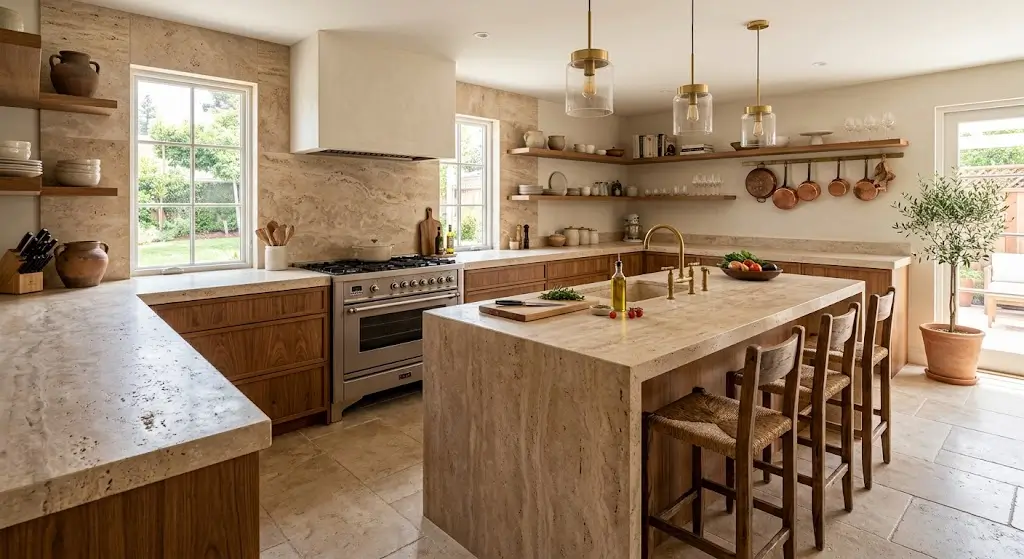
Designing with Travertine Countertops
Interior designers frequently specify travertine countertops across diverse residential projects. The versatile stone harmonizes with luxury, contemporary, coastal, and classic aesthetics. Homeowners place honed travertine slabs in kitchen islands, bathroom vanities, and feature bar counter areas. Wall cladding with matching stone creates a continuous vertical accent in minimalist spaces. For vertical cladding or low-impact surrounds, unpolished wall cladding echoes the organic texture of stone worktops.
To truly elevate the stone’s warm undertones, careful material pairing is key. Crisp white or off-white cabinetry instantly makes the natural ivory and gold veins pop. For hardware, unlacquered brass or bronze beautifully reflects the stone’s inherent warmth, while matte black fixtures offer a striking, modern edge. Ground the entire palette with warm white oak or light limestone flooring, finishing the space with pale linen-toned or warm plaster walls for a cohesive, balanced environment.
Outdoor Kitchens and Bar Tops
Exterior installations require careful evaluation of weather conditions. Travertine exhibits poor freeze-thaw resistance and medium UV color stability. Consequently, stone experts advise against installing travertine in climates with freezing temperatures. Freezing water expands inside surface pores and causes serious cracking.
Comparing outdoor materials highlights significant performance differences between natural surface options.
| Material | Weather Resistance / Freeze-Thaw | UV Stability | Outdoor Application Advice |
|---|---|---|---|
| Travertin | Poor freeze-thaw resistance | Mittel | Avoid in freeze-thaw climates; requires high maintenance in mild areas |
| Granit | Good freeze-thaw resistance | Excellent / Good mineral stability | Top outdoor choice when properly sealed every 6–12 months |
| Concrete | 7/10 weather resistance | Moderate pigment stability | Customizable weather choice; requires sealing and crack management |
Granite offers superior outdoor performance due to low porosity and high weather resistance. Concrete provides solid customizable structures, though natural pigments may shift slightly under direct sun exposure. Travertine performs reliably outdoors only within mild, freeze-free regions when owners maintain frequent sealing routines.
Care and Maintenance Guidelines
Daily Cleaning and Chemical Avoidance
Because travertine is primarily composed of calcium carbonate, it is highly reactive to acidic substances. A splash of citrus juice or wine can instantly cause ‘etching’—a chemical reaction that corrodes the surface and leaves permanent dull, whitish spots.
To protect the stone’s finish and the integrity of the sealant, daily cleaning requires a gentle touch. Always use a dedicated, pH-neutral stone cleaner. Never use generic household surface cleaners, and strictly avoid anything containing bleach, ammonia, or even mild acidic solutions like water mixed with vinegar.
Daily wiping requires a soft microfiber cloth or soft mop. Loose grit acts like sandpaper, so you should remove debris before wiping the surface. You can use warm water mixed with mild liquid dishwashing detergent or a specialized pH-neutral stone cleaner. Alternatively, mix one-quarter to one-half cup of isopropyl alcohol per quart of water for an effective neutral cleaning solution. Blot liquid spills immediately, especially coffee, wine, fruit juice, vinegar, and tomato products.
Homeowners must avoid specific harsh chemicals and rough cleaning tools. Never use the following items on your worktops:
- Acidic liquids like lemon juice, orange juice, and vinegar.
- Harsh chemical wipes such as Clorox wipes, bleach, and ammonia products.
- Scouring powders or creams with abrasive particles.
- Abrasive pads, steel wool, stiff brushes, and rough sponges.
- Rust removers containing hydrofluoric acid.
Sealing Intervals and Stain Prevention
A high-grade, penetrating stone sealer is your first line of defense against fluid absorption. Left unsealed, travertine will rapidly soak up moisture, food spills, and dark oils like a sponge. The sealer works by significantly reducing the stone’s effective porosity, buying you crucial time to wipe away accidental spills before they become permanent stains.
| Frequency | Recommended task | Cost / notes |
|---|---|---|
| Daily | Wipe spills immediately and clean with pH-neutral stone cleaner. | Covered by annual product budget. |
| Monthly | Perform a water-drop sealer test; inspect edges and seams. | No extra cost; catches small issues early. |
| 2–3 times per year | Reseal high-use kitchen surfaces as needed. | Included in $30–$60 annual stone-care product budget. |
| Every 1–2 years | Apply high-grade penetrating sealer across standard countertops. | Professional sealing costs $2–$5 per sq ft. |
Most kitchen installations require fresh sealing every 1 to 2 years to maintain protection. High-traffic kitchen islands may require fresh sealant every 12 to 18 months, while bathroom vanities last 3 to 5 years. Professional contractors charge $2–$5 per square foot for sealing services. Performing a water-drop test every 6 months confirms whether the protective barrier remains intact. Place a few drops of water on the surface. If the water beads up, the barrier remains strong. If the stone absorbs the water and darkens, you must apply new sealer immediately. Maintaining a yearly supply of pH-neutral cleaner and quality sealer costs $30–$60 annually. This modest ongoing investment protects a total countertop investment worth $2,000–$15,000 over many years of heavy domestic use.
Ultimately, specifying travertine countertops is about balancing aesthetic ambition with realistic maintenance commitments. It offers the luxurious warmth of marble at a much more accessible price point, but its porous nature is unforgiving to neglect.
While it shines effortlessly on bathroom vanities, decorative accent pieces, and low-traffic surfaces, utilizing travertine on high-traffic kitchen islands requires diligent care and immediate spill cleanup. By committing to a simple routine—daily wipedowns with a pH-neutral cleaner and a fresh penetrating seal every 1 to 2 years—buyers can confidently protect their investment and enjoy the stone’s timeless architectural beauty for generations.
FAQ
How much do travertine countertops cost to install?
Total installation costs typically range from $45 to $100 per square foot. Material slabs cost between $25 and $60 per square foot. Fabrication and professional labor add $20 to $40 per square foot, while surface sealing adds $2 to $5 per square foot.
Are travertine countertops heat resistant?
Yes, natural travertine stone withstands high temperatures very well. The solid mineral body resists hot cookware better than synthetic materials like quartz, which can melt resin binders. However, using trivets remains a wise practice to prevent sudden thermal shock on the natural surface.
Can you use vinegar to clean travertine surfaces?
No, you should never clean travertine surfaces with vinegar, lemon juice, or acidic cleaners. Acid corrodes calcium carbonate in the Naturstein and leaves dull etch marks. Use warm water mixed with mild dish soap or a dedicated pH-neutral stone cleaner instead.
How often do travertine countertops require sealing?
Most residential travertine countertops need a fresh penetrating sealer every 1 to 2 years. High-use kitchen islands may require sealing every 12 to 18 months. Performing a quick water-drop test helps verify if the protective barrier remains intact.